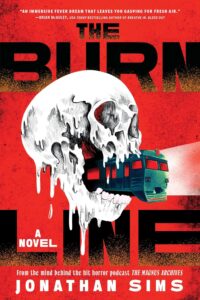
 The Burn Line by Jonathan Sims
 Genres: Adult, British Literature, Horror, LGBTQ+
Published by Poisoned Pen Press on August 24, 2026
Format: ARC, eBook
Pages: 384


Source: Netgalley
From the dark and twisted mind behind the podcast sensation The Magnus Archives comes a suffocating, socially charged nightmare that reveals how fear festers in the cracks of everyday life…
Beneath the streets of London, it hungers…
It's the hottest summer on record and the city is suffering. Prices are high, pay is low. And on one fateful morning five travelers find themselves trapped in a tube car deep in the London Underground.
It will change their lives forever.
By the time they leave the train they will be bound together as witnesses to a single horrific event. Something terrible, irreversible, and monstrous. Something hungry.
But they can't remember what it is.
On their own, they each begin to experience strange dissociative events. Time gets lost. Friends disappear. Something stalks them in the shadows. They make an unlikely team, but to remember what they encountered that day on the train, they will have to work together. Because now it's up to them to understand what horror they saw – and stop it in its tracks before it drags everyone else down below.
This review is based on a complimentary Advanced Reader Copy provided by Poisoned Pen Press.
A creature feature novel set in the tube, Jonathan Sims’s The Burn Line is a well‑crafted horror story that’s a quick read and something a bit different from the norms of the genre. Blending underground eldritch tension with English commentary on wealth disparity and social stigmatization, it features a multi‑POV presentation and a diverse set of characters with good representation. While some may have mild issues with the uneven pacing and the book’s slower middle section, it’s an otherwise polished and solid debut and a perfect sweltering summer read, unless cooler‑weather escapism is preferred.
This book is set in the summer of 2022 during the UK’s unprecedented heatwaves that were not only historic by climate‑tracking records but also deadly. In addition to the record‑breaking weather, 2022 was still part of the Covid pandemic as well as a particular royal‑family‑related event that is included in this novel. Underground tunnels and subway systems have been used as the basis for horror novels before, but what makes The Burn Line unique is the heatwave element that gives the story a distinctive feel. Where many other books mention chilling realizations or goosebump moments, this one instead features sweltering heat, sweat, and delirium that create a different narrative flavor. The emphasis on the heatwave is particularly interesting and relatable given the increasing frequency of these weather patterns both in the UK as well as abroad (I’m based in the US and read this ARC while going through its own summer heat dome).
The book’s horror element is essentially a creature feature of the eldritch variety, but Sims’s take on it has a few unique angles. The story has a strong element of the unknown as its characters cannot remember what they may have seen or experienced beyond the unsettling intuition that something bad happened. Elements involving a putrid smell, eroding and ashy traces left behind, and the unbearable weather all play off the book’s heatwave motif. The other important element is the tube, this story being one that could really only work with London’s hallmark underground transit system. The threats, attacks, and various character backgrounds are all well‑connected to the underground line, hence the book’s title.
One of the book’s most notable aspects is its multi‑POV presentation that follows five main characters whose otherwise separated lives are connected by a shared horrifying experience on the tube that no one can remember. Each character has distinctively different personalities, backgrounds, and careers with great ethnic, socio‑economic, and queer representation. The split‑POV setup is used effectively not only to show the extent of the horror elements underground, but also to space out the investigative elements and the story’s big picture. The POV transitions are also used strategically with little to no redundant scenes or recapping involved (a notable issue I have with many poorly planned multi‑POV books), shifting to the character whose professional background or personal experiences best suit a given section, and covering more physical ground. Apart from the first round of chapters that are focused on introducing each character and their backgrounds, the POVs are all interconnected with the sole exception of one character for important narrative purpose.
In addition to the main horror story, this book features a good amount of societal and political commentary whose related themes are tied back to the creature’s lore. Wealth disparity and stigmatization against the homeless are notable topics, represented with all five characters sitting at different points on the wealth spectrum. Gentrification of the area is also touched on, as well as the power, importance, and superiority of those with resources. This is demonstrated as crucial as hoarding necessities while others struggle or evicting the poor, to as simple conditions like having functional air conditioning in a heatwave, one whose real-world inspiration contributed to the death of nearly three thousand people in the UK alone. While this is first and foremost a horror novel, at many times it can resemble contemporary fiction as well, given its strong character writing and commentary, the two sides nicely balanced for most of the story.
While the story is presented well, it has a few minor rough spots. Horror novels live and die based on whether they can maintain good ambiance as well as tension. While this book does a great job with the former, there are times where the pacing can start to drag, which in turn can affect the latter. While I appreciated the detailed character work and diverse backgrounds, some of the characters’ personal stories can feel a bit dry or irrelevant at times, particularly during the second rotation of POVs in part two. The material is interesting, but for readers that are only interested in the book’s horror content, this section can be quite dry, particular POVs like Will’s. Other characters such as Tash are a highlight to follow from a personality and narration standpoint; her chaotic roommate situation and identity as a trans woman make her more memorable than say Senyo, whose main personality traits are being paternal and family‑oriented. However, her POV and background in the greater scheme of things don’t feel like they contribute much to the overall story. Senyo, on the other hand, provides a lot of good clues and insight given his job as a train driver and civil servant worker, but I found his chapters to be my least favorite and inspired personally.
The other weak area is the book’s focus on its social and political themes and commentary that’s in an odd spot where they feel underutilized and developed for full thematic impact while also feeling like a side tangent. Thriller‑horror books tend to be on the shorter, snappier side, but this one felt like it could’ve benefitted from an additional part or round of POVs to do it flesh out its discussion on excessive wealth. The commentary was quite good but felt like it didn’t go quite far enough for its connections to the creature’s origin and lore to land fully. The choice to set this story in 2022 makes sense as there’s an interesting reference made at the end of the book related to an event that happened that year, but it’s a blink and you miss kind of detail. The pandemic setting also feels underutilized and gives the story a dated feel despite it only being set four years ago. The slow‑burn mystery set against great character work for the first two thirds of the book feels like it could’ve used more horror moments to up the ante, while the last third feels like the action and story are running on fast‑forward speed. Unfortunately, the action‑heavy chapters and discoveries of what’s going on underground were some of the least interesting parts of the book for me personally, missing the good character dialogue and distinctive narration present earlier; not a great note to conclude the book on.
Atmospheric in a different style from most other horror books, The Burn Line is a well-written character-driven book that sets itself apart with its unique heatwave premise. Featuring diverse and effective character writing, great representation, light social commentary, and making good use of its multiple POV structure, it’s a polished horror novel and a respectable author’s debut that does a lot of things well. Just be sure not to read it before heading underground, or worse, on a subway line unless interested in an unsettling ride that may or may not involve temporary memory loss-