
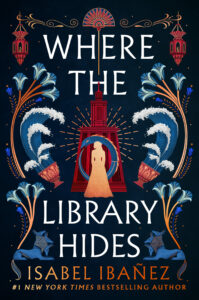
 Where the Library Hides by Isabel Ibañez
 Series: Secrets of the Nile #2
Genres: Fantasy, Fantasy Romance, Historical Fantasy, Low Fantasy, Romantasy, Historical Fiction, Young Adult
Published by Hodderscape on November 4, 2024
Format: Hardcover, Special Edition
Pages: 388


Source: Goldsboro Books
Where the Library Hides is Isabel Ibañez's stunning conclusion to the story that started in What the River Knows. A lush immersive historical fantasy set in Egypt filled with adventure, and a rivals-to-lovers romance like no other!
Inez Olivera traveled across the world to Egypt, seeking answers into her parents' recent and mysterious deaths. But all her searching led her down a perilous road, filled with heartache, betrayal, and a dangerous magic that pulled her deep into the past.
When Tío Ricardo issues an ultimatum about her inheritance, she’s left with only one option to consider.
Marriage to Whitford Hayes.
Former British soldier, her uncle’s aide de camp, and one time nemesis, Whit has his own mysterious reasons for staying in Egypt. With her heart on the line, Inez might have to bind her fate to the one person whose secret plans could ruin her.
The answer arc and part two of Ibañez’s Secrets of the Nile duology, Where the Library Hides is a sequel that many fans of the first book likely didn’t sign up for. While continuing its 19th‑century Egyptian premise on paper, in many ways this book feels like a product of misguided and unfortunate creative and narrative choices. Focusing heavily on familial conflict, betrayals, and character drama rather than its compelling historical fantasy elements, it may not be every reader’s cup of tea.
This book picks up right after Where the River Knows ends, following the dramatic events in the backstreets of Cairo. While the first book posed a lot of interesting and mysterious questions about Cleopatra and Whit’s traumatic history in the armed forces, most of those storylines were left unresolved, compelling material for Where the Library Hides to answer. Where book one covered exploration and discovery on the island of Philae, this book sees Inez and Whit drawn to the ancient and war‑torn city of Alexandria with all of its famed history and lore.
Starting with the positive points, Ibañez’s casual yet polished prose continues to be well‑suited for YA readership, as does Inez’s character narration, which is fitting for her age and background. The reflections, stress, and concerns she feels match her well, and this book features more prominent scenes from Whit’s POV. And while visuals and sensory descriptions aren’t featured as heavily due to the story’s focus on character drama rather than exploration, they still make the book an immersive read, albeit less impressive and consistently utilized compared to the first book.
Unfortunately, that is where the positive aspects end. I found this sequel incredibly disappointing almost across the board, the read growing progressively more frustrating and tiring to push through. The chief complaint I had is that this book focuses on the weakest elements of the first book while simultaneously throwing out or wrecking its strongest ones. The underlying problem seems to be that there wasn’t enough plot or story to justify a duology with the ideas available. While the first book’s middle section felt deliberately slow and dry, the same could be said here but considerably worse, as it’s not just a few parts but rather the first three hundred pages of a four‑hundred‑page book that feels like a waste of time and resources.
Where the first book was a nice mix of 19th‑century historical fiction, ancient Egyptian exploration, light fantasy, and romance, Where the Library Hides makes the deliberate choice to focus almost exclusively on romantic tension, domestic conflict, and familial drama. To achieve that, however, Ibañez heavily relies on miscommunication, giving nearly all of the conflict a manufactured and juvenile feel at odds with how polished the series had been up to this point. While I previously thought exploring Whit’s backstory with the British forces would be interesting, this book explores it poorly, with the entire first arc feeling shoved into the story. Almost all of the content in the first half feels like an unnecessary tangent that slows the mystery to a complete halt, while the drama and miscommunication feel repetitive and tiring. What was once a balanced fantasy‑romance historical fantasy book sharply pivots into a romance‑heavy one that throws trope after trope regardless of whether they narratively fit the characters or their actions. There’re little fantasy and historical elements at all apart from the Egyptian setting for most of the book.
To make matters worse, Inez and Whit’s charming and delightful chemistry, which carried the series through its narrative highs and lows, is completely gone at the start of this book and never really returns. A lot of this stems from how Ibañez handles Whit’s character writing and his more prominent POV, given that Inez would make a poor narrator for his history. The issue is not only does Whit’s POV lack the appealing spark of Inez’s, but his character also feels quite different and devoid of the dark humor and wit that made him so likable. Part of this could be explained through narrative context, he’s no longer hiding behind his sarcastic and protective façade, but the way he acts and behaves feels like someone entirely different. Miscommunication can be an easy crutch to increase tension, but here it feels unnecessary, unpleasant, and accomplishes very little in terms of character depth or story.
On the other side, Inez is likewise rough to read about for completely different reasons. While I previously commented that her stubbornness and resilience were marks of good YA writing, those aspects were balanced by her resourcefulness, which helped justify her impulsive actions. Her portrayal in this book doesn’t achieve that balance. Inez constantly comes off as immature, bratty, and uncharacteristically prone to giving up, which is at odds with how resilient she was in the first book whenever a door closed to her. The story also does her dirty by throwing predictable twist after twist at her, betrayal upon betrayal at the surprise of no one but her. Inez is meant to be intelligent, but this book fails to show that strength at every opportunity. This is the same issue I had with Ravenna in Graceless Heart, where the plot insults the character’s intelligence, in Inez’s case, having her trust everyone around her only for them to betray her constantly. Her dialogue about Isadora is particularly grating, often far removed from how teenagers or young adults actually talk. As a result, many may find her unlikable and difficult to root for, on top of her quick judgments and out‑of‑left‑field negative assumptions about Whit. The whole affair feels like low‑quality filler.
Issues with character writing extend to the supporting cast, an area already weak in the first book. As I mentioned in my review for What the River Knows, Isadora is featured far more prominently here but continues to feel like a missed opportunity. Her character is kind of a maverick, not because she’s unpredictable which likely was the intent, but because there’s no consistency in her hot and cold actions and personality. This not only makes Inez appear even more foolish but also makes her more unlikable when she argues with Whit over their differing opinions and trust in Isadora. Plot twists around her, her father Charles, and connections with Uncle Tio and Inez’s parents are certainly unexpected but not in a positive way that feel more circumstantial than deliberately planned. On the flip side, Abdullah’s daughter Farida who was mentioned but largely absent in the first book, also feels unnecessary and forgettable whenever she appears. But the worst offense is the character writing for the villains at the end of the book, whose actions and dialogue are as cheesy and laughably terrible as a children’s cartoon. I previously noted in my review of Graceless Heart how the Pope was ridiculous and hilarious in a completely unintentional way, and the same could be said about the villains here. This is combined with a last‑minute plot twist that, in my opinion, is utterly cheap and thrown in for shock value regardless of how unbelievable it is. I legitimately laughed out loud in disbelief, followed by anger at how poor a twist it was, destroying the story’s credibility.
Numerous character writing issues aside, the other major problem is the story’s lack of substance and direction. While the book comes in at just over four hundred pages, only the last hundred have real substance that covers the series premise and long‑running mysteries. The book’s namesake library isn’t mentioned until over three hundred pages in, and apart from a few quick uses of magical artifacts, one could easily forget they were reading a fantasy book at all. Similar to the first book, the last hundred pages abruptly shift in pacing and content, again coming off as incredibly rushed, messy, and chaotic. It’s even more noticeable this time around given how many pages feel like filler tangents or side stories no one cares about. The historical fiction elements based on key historic places in Alexandria are great on paper and a treat when featured, but it’s too little too late after so much unnecessary drama. By this point, I couldn’t care less if Cleopatra rose from her casket and cursed them all, I didn’t find a single character likable which was the opposite of how I felt when reading the first book.
As a fantasy romance book set in 19th‑century Egypt, Where the Library Hides is a decent enough read. For readers who enjoy drama, familial secrets, constant betrayals, and miscommunication, it can even be quite solid. However, as a sequel to the premise and story established in What the River Knows, this book is, for me, a nearly complete failure. Its narrative content pivots away from the previous book’s most compelling storylines, and the endless conflict and suspicion that replace them can be frustrating to read. This book also throws out almost every element that made the first book fun and charming, especially Inez and Whit’s banter, camaraderie, and chemistry, which is a key make‑or‑break factor for fantasy romance or romantasy books. I consider the first book fantasy romance and this one romantasy. And that’s excluding the chaotic and messy ending that made me livid with how poorly executed and ridiculous it was (hint: it’s related to white facing). This is now the third book I’ve read from Ibañez with a rushed and chaotic ending, two of which I actively disliked as a whole. While this review may sound harsh, it brings me no satisfaction to write it, as I genuinely loved the first half of What the River Knows. I read other negative reviews for this book and could not imagine my impression of the series falling so low. It’s all the more frustrating because Ibañez’s writing is quite good and the ideas are there; it’s the execution and creative choices that sabotage the story. This isn’t a mediocre book, but a misguided one. The title of this book shouldn’t be Where the Library Hides, but Where the Story and Charm of the Series Hides.