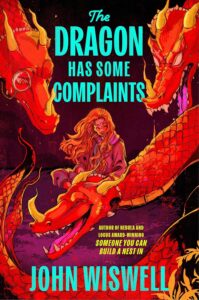
 The Dragon Has Some Complaints by John Wiswell
 Genres: Adult, Fantasy, Dragon, High Fantasy, LGBTQ+
Published by DAW on July 13. 2026
Format: ARC, eBook
Pages: 400


Source: Netgalley
Garrodigh was once a four-headed dragon, among the most powerful in Kardoša. After an unfortunate incident, he now has three heads, one stump, and a daily whirlwind of internal bickering. Centerhead wants to rain death upon all humanity, Bottomhead is like a feral cat, and Upperhead is under the delicate delusion that he is, in fact, human.
 When a nearby battle goes awry, Garrodigh sneaks into an elite dragon rider academy, pretending to be tame to get free food and a warm bed. Lucky for him, rider Rania Albright is desperate enough for a dragon of her own that she overlooks his eccentricities.
 As Garrodigh recovers under Rania’s care, all three heads start to turn, for the first time, in the same direction. Each wants to protect her from the invaders who killed their fourth head—the same invaders who seek to conquer Kardoša. When the academy comes under attack, can this wild dragon and his wilder rider save their homeland together?
 This cozy fantasy intertwines epic battles with loving friendships, sharing an utterly unique perspective on what it means to be a "monster."
This review is based on a complimentary Advanced Reader Copy provided by DAW.
A floating city, foreign invading airships, an immigrant woman who longs to be a dragon rider, and a three-headed dragon who’s tired and wants to remind humankind that he is to be feared. Following a jaded three-headed dragon whose heads comically quarrel amongst themselves, John Wiswell’s the Dragon Has Some Complaints is a book pitched as a cozy fantasy meets epic fantasy story of battles, friendship, and reflections of being a monster. With earnest intentions, this book succeeds in the friendship department with lots of positive therapeutic empathy and inclusive queer representation. Yet, its other aspects feel less successful and cohesive resulting in a somewhat disjointed and underwhelming reading experience.
Based on its premise and marketing as a light-hearted fantasy story, that one goofy three-headed dragon fanart meme instantly comes to mind. And though I can’t verify if this provided any inspiration for the book’s concept, it invokes a similar tone, at least initially. Garrodigh’s three heads act the three stooges; Centerhead being the leader and snarky one, Bottomhead who is feral one (the book’s description not mine, they seemed more like the impulsive child than feral to me), and Upperhead who is the anxious and slightly neurotic one who is convinced he’s a human trapped in a dragon’s body. Garrodigh also carries the metaphorical and physical weight and loss of their fourth head Lefty who sympathized and hoped to work collaboratively with humans; their name also doubling as an apt socio-political association compared to most dragons who detest humans. The first half of the book follows Garrodigh’s infiltration of the human’s Winged City, a plot of land blessed by the dragon goddess who bestowed upon the ability of flight. While masquerading as an injured tamed dragon taking advantage of the humans’ food and supplies, he’s paired with a young lady Rania who’s dreamed of becoming a rider.
The front half of the book is where this book feels the most light-hearted and comical courtesy of Garrodigh’s three heads and their endless banter. Determined to learn all he can to one day overthrow Winged City, what actually happens is the three heads are constantly baffled and confused by human behavior such as avoiding what they want to say, strange contraptions to torture- erm rehabilitate dragons, keeping track of who doesn’t like who, and even frequent rubbing meats together outside their barn stable; aka frivolous one-night stands (it’s not spicy nor described on-page). Despite how stubborn and firm they are to soon devour them all, Rania’s constant doting and positive reinforcement slowly starts to sway them from their original goal, becoming attached to the person they meant to betray. The story has a very warm and comforting feel to it and the story for me is at its best when it’s focused on Garrodigh and Rania, bridging the divide between humans and dragons.
Introduced as caring and kind-hearted, Rania is the kind of character that wears their heart on their sleeves and is easy to root for. Although she has always dreamed of being a dragon rider, her background as a refugee/escapee from the FFR (more on that shortly) makes others immediately distrust her as a potential spy from the enemy. Rejected as a rider until Garrodigh arrives without a paired rider, she does everything in her power to bring him back to full health, showing him the kindness and affection he never had amongst the other wild dragons. On the flip side, unconsciously against his better judgement, Centerhead can’t help but want to protect Rania in return, whether its physical threats from the invading airships or from emotional pains of heartbreak or grief. There’s a lot of support and love for others in this book, their bond being a great example of it.
Once the book transitions into its back half, the story begins to shift and takes on a more action-forward and grave approach. Though it’s vaguely foreshadowed early on, the nation of Kardoša and the Winged City is under constant threat from the FFR’s invading airships and deadly cannons. Despite the early comical and light-hearted introduction, the story pulls out some unexpectedly big battles and dragon flight combat that’s more on-brand with epic fantasy stories; this book’s marketing describes it as a cozy fantasy but I don’t agree with that label as the content is not at all what people consider the sub genre to be. The stakes and world-building lore grow as the story progresses, culminating in a surprisingly grand finale that one wouldn’t expect given the book’s unassuming beginning.
In addition to the mix of comedy and grand battles, another one of the book’s highlights is its queer representation and its themes of found family and home. The Dragon Has Some Complaints is set in a queer normative world that extends to all of its characters. While not discussed, Rania is likely pan, the first knight Olesksiy is a trans man, Rania has some flings with men and women who also have feelings for others, etc. The book’s themes of found family not only apply to their queer identities (Oleskiy’s childhood of concealing who they are is lightly touched on) but also to their home in Kardoša vs where they were originally from. Outside of Rania and Garrodigh, there’s a lot of soft feelings, a found family support group, and a sense of therapeutic healing from the pains of their past.
If evaluated on paper, the Dragon Has Some Complaints has a lot of great ideas. Airship battles, a floating city, interesting lore about a dragon goddess, a refugee state at risk of being conquered, and of course dragon riding. However, though the book tries hard to be comedic while also grand, the end result doesn’t quite come together in a satisfying way. Despite enjoying both epic fantasy books as well as comedic satirical ones, I found this one’s pairing of the two to be a bit awkward and the overall story to be very underwhelming and slow. Its first half and middle section felt to me like it was fumbling to find its hook and had too much filler. Additionally, rather than blending its humor and action well, it felt like the book couldn’t figure out what it wanted to be. It’s kind of cozy but loses that charm half-way though, it’s kind of funny but the three-headed banter gets old (particularly Bottomhead whose interjections get very repetitive), the stakes are high but notable plot details don’t make sense while the world-building is limited at best. This novel tries to do a lot of different things but unfortunately ends up doing them all rather weakly. I felt like the novel was more memorable when it was light-heated, and I wished it leaned more in that direction than its mid-way noncommittal approach.
Garrodigh’s rehabilitation process was well done in the early chapters (likely attributed to Wisell’s physical disabilities and experiences) but it was surrounded by a lot of character drama that felt juvenile and surface level. Ordinarily this wouldn’t be a dealbreaker, but the problem is that this book is pitched as an adult novel with characters in their 20’s and up. The character dynamics and relationship woes felt akin to high school drama, he said she said and jealousy included. All of the human characters’ actions and dialogue felt far too young for how old their characters were meant to be; the story likely would’ve made more sense aging them down if not for the book’s frequent sex flings that didn’t feel like they added much (closed door mind you, though they ironically happen outside). I felt like the conflict and melodrama felt very forced and almost silly, slowing down and dragging a plot that could’ve used the pages for better world-building, exploration of the dragon riding mechanics, or even the character’s backgrounds, Cosmos and Olesksiy specifically.
Each character also felt like they had a single defining trait which made them feel like caricatures rather than fleshed out individuals; Rania caring too much, Olesksiy flirtatious and gallant, Cosmos abrasive and guarded, and the Minster pragmatic. There were great narrative ideas like Cosmos’s background and affiliation with another nation or Olesksiy’s being unable to come out and identify with who he was growing up that were simply skimmed over or introduced in a casual flippant manner. The dialogue also felt lackluster, particularly with Rania who felt almost comically over-caring to the point where it felt comically forced. On top of the weak character writing, the story has the aforementioned theme of loving friendship and support of each other. In theory the theme is a wonderful and wholesome idea, but the execution felt overly saccharine and heavy-handed. Safe and coziness are rather subjective, and I can see their circle of therapeutic support for each other to be comforting for some readers, but I struggled with these sections due to the shallow nature and explorations of each character’s trauma and history. I would’ve liked if Wiswell went further with each of these elements considering other parts of the book have moderate graphic violence and death involved, the book skirting what would be considered cozy fantasy already.
As the story intensifies, the book felt progressively unfocused with what it was trying to accomplish. The Winged City being at risk of invasion or diplomatic takeover are fine storylines on paper, but the lack of world-building means there’s almost no context to who Kardošans are, their only identity being scrappy refugees against the big guys. Motivations are revealed as they are happening during political negotiations with little setup or foreshadowing, xenophobia isn’t effective as an underlying theme without the history behind it, and by the end of the book it’s still unclear who the FRR even are and why they are invading except for “power”. The dragon lore and Goddess legend are initially interesting but certain reveals start to stretch what is believable, the mechanic behind how the FRR suddenly appear near the Winged City defying the laws of physics and velocity without some gimmicky original in-lore explanation like how dragons are able to achieve flight.
While lackluster on a macro level, the details are also conflicting and inconsistent. Garrodigh’s heads are intrinsically familiar with some of human settlement buildings, roles, and purposes, but they don’t understand the concept of lying or hesitancy on top of suddenly knowing things they shouldn’t know (there’s a plot device that could potentially explain it though it’s a cheap copout). Rania is barred from being a dragon rider due to her origin while Olesksiy is immediately given a high status and is tasked with overseeing new recruits the first week he arrives at Winged City when they’re from the same place? Rania also immediately knows how to fly and steer a dragon in flight despite having no formal training and being illegible to ride one? Buildings are built to obscure the eyes of a large being despite them being perpetually asleep and unable to see anything anyway? Garrodigh is introduced to Olesksiy and the dragon immediately narrates that he’s a trans man, how exactly does the dragon know this instantly (a notable drunken Rania scene that occurs soon after would’ve been a far more effective chapter to reveal Olesksiy’s identity)? Rania has the ability to see and read people’s aura which is never explained and is the only ESP type of power in the whole book. A casual reader may not necessarily notice or take issue with these discrepancies or oversights, but as a veteran SFF reader, I found the plot and details all over the place. The more intense the story got, the messier the reading experience felt, the book being much stronger as a light-hearted fantasy story vs a dramatic and action-forward one.
Juggling lighthearted humor with serious stakes and cozy vibes followed by intense action, the Dragon Has Some Complaints is a book of mixed elements that lead to a mixed reading experience. Featuring a lot of interesting ideas and storylines, the overall execution unfortunately holds the book back from reaching the fun and heartfelt novel with crossover appeal it’s shooting for, not to mention the story being quite dry and far longer than it need be. I feel a little bad about scoring this on the lower end as I can tell Wiswell had great intentions with its queer representation, supportive found family friendships, portraying the struggles of rehabilitation and more, but at the end of the day I just didn’t find it particularly interesting to read. For the sensitive reader looking for a safe and comforting story with pops of action, or queer literature readers wanting to venture into epic fantasy stories, this can be a wonderful hand-held read. Unfortunately, for more experienced SFF readers or those that may find the therapy-heavy character work to be dull or off-putting, the Dragon Has Some Complaints may leave them with some disappointing complaints of their own.