
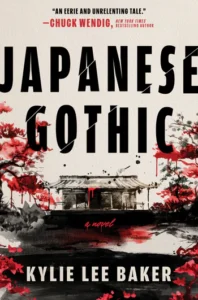
 Japanese Gothic by Kylie Lee Baker
 Genres: Adult, AAPI, Japanese Literature, Folklore, Gothic, Historical Fiction, Horror, Psychological Horror, Mystery Thriller, Thriller
Published by Hanover Square Press on April 13, 2026
Format: Hardcover
Pages: 352


Source: Aardvark Book Club
In this lyrical, wildly inventive horror novel interwoven with Japanese mythology, two people living centuries apart discover a door between their worlds.
 October, 2026: Lee Turner doesn’t remember how or why he killed his college roommate. The details are blurred and bloody. All he knows is he has to flee New York and go to the one place that might offer refuge—his father’s new home in Japan, a house hidden by sword ferns and wild ginger. But something is terribly wrong with the house: no animals will come near it, the bedroom window isn't always a window, and a woman with a sword appears in the yard when night falls.
 October, 1877: Sen is a young samurai in exile, hiding from the imperial soldiers in a house behind the sword ferns. A monster came home from war wearing her father’s face, but Sen would do anything to please him, even turn her sword on her own mother. She knows the soldiers will soon slaughter her whole family when she sees a terrible omen: a young foreign man who appears outside her window.
 One of these people is a ghost, and one of these stories is a lie.
 Something is hiding beneath the house of sword ferns, and Lee and Sen will soon wish they never unburied it.
Blending together Japanese samurai culture, time-travel speculative fiction, tense horror ambiance with mystery thriller intrigue, Japanese Gothic by Kylie Lee Baker is as ambitious of a novel as it is graphic and violent. One of the most anticipated horror releases of the year, like her inspirations and goals, this book crossovers between genres, storylines, and realities, telling a compelling and gripping story in just over three hundred pages. Steeped in Japanese folklore and culture but presented in a way that’s accessible, Japanese Gothic is an excellent mystery thriller/horror novel that’s powerfully written and creatively conceptualized.
There’s a lot that could be said about Japanese Gothic’s story, but this is one book that’s best experienced on its own with minimal overview given the tension, mysterious intrigue, and unexpected narrative elements benefit from the reader being left in the dark. The book features a split POV and timeline perspective that’s similar to Lee’s presentation, a meeting of the East and West. In 2026, Lee Turner escapes to his father’s house in Japan following the murder of his college roommate that he can’t remember how or why he killed. Racked with anxiety and paranoia, his chapters follow his descent into borderline psychosis as he struggles to keep track of what is real, what is a delusion, and whether he can trust what little he remembers. Upon arriving at the house hidden by sword ferns in the forest, perplexing changes to the property occur, memories are triggered, and his dad’s girlfriend is unreadable while his father is detached and distant. Meanwhile in 1877, Sen is a young woman and one of the last samurai left following their exile and imperial persecution in the Meiji era. Struggling to appease her cold, unforgiving, and brutal father who pushes her to her physical and mental limits, she’s faced with conflicting loyalty to herself vs her family and their very existence to survive under the looming threat of the imperial army.
On paper, Japanese Gothic has a premise that has too much going on and sounds like it shouldn’t work. Lee and Sen have wildly different character narratives, conflicts, and even their chapters have quite different tones; Lee’s resembles a psychological thriller while Sen’s a historical fiction and literary novel. At first glance, the two characters and their perspectives have nothing in common except being set in a rural and mysterious house nearly a hundred and fifty years apart. However, what makes Japanese Gothic such an interesting read is the way the two seemingly different stories play off each other and interact. Initially atmospheric and slower paced, once Lee and Sen’s stories meet across time, the book becomes an intense and consistently compelling read that’s bingeable and well-paced. Additionally, the narrative presentation makes excellent use of the unreliable narrator approach where what’s real, a delusion, a memory, or a dream are impossible to separate from each other; this is particularly impressive as the book is written in 3rd person rather than 1st person perspective.
Given its presentation, the plot is very unpredictable which constantly keeps the reader on their toes. While certain narrative elements or moments seem obvious and predictable, they almost function as a bit of a false front where there’s added unexpected details or context behind them. The book consistently maintains self-awareness of the reader’s sleuthing, with most of the book a slow burn trek to both character’s doom (time-travel and predetermined fates) before pulling the rug out from underneath itself and giving new meaning to previous scenes that seemed odd, irrelevant, or confusing. I like to think that I’m a pretty intelligent and detailed reader, yet even I felt the need to re-read previous chapters to fact-check that the book had properly set up its surprises and reveals (it does). The book takes an open-ended and bittersweet approach with its ending that may leave some casual readers confused or disappointed if they were expecting a decisive and clear conclusion, but it’s one that’s literary and thoughtfully executed in a manner that’s appropriate for its time-traveling and speculative fiction adjacent premise.
Besides the highlight Samurai and Japanese culture depictions that I’ll get into shortly, Japanese Gothic features great thematic depth and character writing. While the two stories seem different initially, both are focused on family, acceptance, and (the lack of) love. Sen’s harsh and difficult relationship with her father is the more obvious of the two, but Lee’s unnatural, stilted, and lying-filled interactions with his father are just as unhealthy that many would deem toxic. Both young characters are repeatedly dealt difficult hands, yet still try to make the best of their grave situations. Sen appears to be the more admirable and honorable one of the two while Lee’s murderer on the run and psychosis paranoia can be harder to get behind, but both are ultimately striving for the same thing of holding on to the impossible dream of a happy and whole family unit or what could have been. Their stories are made all the more compelling yet tragic once they meet and find solace in each other, being seen and understood for the first time despite the cultural and temporal divide separating them. Years apart, their shared feelings of isolation is well portrayed.
While still a horror and mystery thriller novel, Japanese Gothic is also a legitimate historical fiction novel thanks to its solid depictions of Japanese culture, folklore, and samurai traditions. In her author’s acknowledgements, Baker writes that she strove to write a book that honored her mixed heritage roots and presented a nuanced exploration of the samurai legacy. Neither demonizing nor glamorizing samurai culture, the book depicts many of the conflicting and harsh realities of the samurai’s honor, training, and “code” in a manner that’s often brutal, shocking, yet riveting. While the horror elements in Lee’s chapters follow more familiar psychological thriller beats, Sen’s chapters have horrors where honor and sacrifice are taken to an extreme. I personally found the brutality of Sen’s story and her relationship with her father more horrifying than Lee’s more overt horror moments, the dread being quieter and more serious vs spooky or jump scare style horror elements. The book also does a very respectable job at presenting hakujin vs nihongin interactions, or Japanese culture in general to Western readership that’s accessible while still providing great representation. The story also has a folklore aspect to it thanks to the book’s connection to the story of Urashima Taro, one of the most famous Japanese folklore fairy tales that all Japanese kids are familiar with, myself included. Baker also doesn’t hold back from even tackling topics like Western “preference” for Japanese women, a white man in an east Asian studies collegiate setting, gender roles both in the modern and historic setting, etc. There’s a lot of strong narrative and thematic material packed in.
While the story is thoughtfully crafted and is a great reading experience, there were a few small things I found myself nitpicking. The overall story’s strong connection with Urashima Taro conceptually makes sense and is well utilized, but I personally would’ve liked for the book to spend more time with it or introduce elements connected with it earlier. As currently presented, it’s perfectly functional but I can see its ending coming a bit out of left field for casual readers that gloss over or speed through the limited chapters recapping the famous folklore tale or are not familiar with it in general. While Sen’s perspective is gripping and brutal to read about, I found myself generally less invested in Lee’s story and conflicts, which is a bit odd considering how his chapters have more of the mysterious content and intrigue in them. While well-written, his character’s personality is one that I can see some sensitive readers finding unappealing and difficult to root for until the book reveals its major plot twists three quarters through; the depiction of his mental health challenges and anxiety is well done however. And while not necessarily a drawback, it is important to note that his book has graphic violence, brutality, and domestic/child violence or abuse involved. That is to be expected to a certain degree given its horror tag and classification, however sensitive readers should definitely check their triggers prior to picking up this book.
A creative book that pulls elements from various genres while delivering a gripping reading experience, Japanese Gothic is a solid novel. Narratively there’s a lot going on and the story is one that could’ve easily devolved into a convoluted mess, but Baker skillfully utilizes the dual perspectives, timelines, and character journeys well. I personally read and own the gorgeous foiled Aardvark Book Club edition, and at least two other notable book box subscriptions will also be featuring this book, which is a sign of its appeal and positive early reception. While its brutality may make it a difficult read for sensitive readers and its plot can feel more like a mystery thriller or historical fiction novel rather than a straightforward horror one, Japanese Gothic is an otherwise well-rounded and excellent book. As one of this year’s most anticipated horror releases, it certainly lives up to its hype and cements Kylie Lee Baker as a versatile and powerful writer.