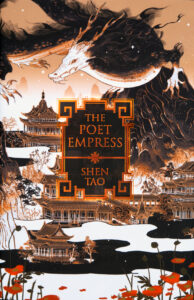
 The Poet Empress by Shen Tao
 Genres: Adult, AAPI, Fantasy, Epic Fantasy, Low Fantasy, Magic
Published by Gollancz on January 19, 2026
Format: Hardcover, Special Edition
Pages: 390


Source: Illumicrate
In the waning years of the Azalea Dynasty, the emperor is dying, the land consumed by famine, and poetry magic lost to all except the powerful.
 Wei Yin is desperate. After the fifth death of a sibling, with her family and village on the brink of starvation, she will do anything to save those she loves.
 Even offer herself as concubine to the cruel heir of the beautiful and brutal Azalea House.
 But in a twist of fate, the palace stands on the knife-edge of civil war with Wei trapped in its center…at the side of a violent prince.
 To survive, Wei must harden her heart, rely on her wit, and become dangerous herself. Even if it means becoming a poet in a world where women are forbidden to read—and composing the most powerful spell of all. A ballad of death...and love.
A story of survival, power, political strategy, and family, Shen Tao’s The Poet Empress is a stunning epic fantasy book with strong historical Chinese-inspired flavor and culture. While the story is one of power succession and imperial palace politics, this book goes beyond that through its complex familial relationships and important contextual backstories. It isn’t a simple story about a resourceful betrothed navigating court survival but is just as much about the events and pressure that led to the making of a tyrant and how the potential for power can destroy everything. Tense, brutal, beautifully poignant, and NOT a romantasy, this is easily one of my favorite reads so far of the year and one of the most ambitious debut novels most authors would dream to have under their name
While featuring a fictional land and dynasty, the Poet Empress tells a sweeping fantasy story that is heavily inspired by Chinese culture and one that could’ve easily taken place in history sans the fantasy and magic. The book incorporates familiar historical elements of male heirs, large groups of female concubines, eunuchs, and a taxation and imperial system much like other well-known established dynasties. While the majority of the book covers political strategizing and chess like movements between different power groups and alliances, the book’s fantasy elements are unique and creative when they do appear. Generally speaking though, their potential and capabilities are more integral to the story rather than direct on-page depictions. The use of written poetry as a basis for magic and spells is not only a powerful thematic point given that women are banned from learning to read and write, but also provides wonderful opportunities for metaphorical poetry and meaning. This book isn’t an epic fantasy book of heavy action or flashy fantasy fights, but is one that uses its material very effectively via the opportunities and implications of said powers. This is a tale of strategy, alliances, betrayal, keeping your friends close and your enemies even closer.
It’s tough to describe or recap what makes the Poet Empress such a brilliant and powerful book without experiencing it directly, but what I can say is that Tao’s storytelling and plotting is consistently excellent. What starts as a seemingly straightforward story about a rural farm villager daughter who offers herself as a potential concubine to the most deadly and cruel royal heir for the sake of her starving family quickly develops into a story of immense scale and political intrigue. As Wei flounders as a fish out of water in the opulent palace full of unspoken rules and customs, she not only has to survive repeated instances of torture at the hands of her prince Terren with his immortality and enchanted blades, but also threats from the other concubines, the other princes’ supporters, and the bitter empress, all of whom want her dead. Realizing how dangerous Terren is both in the palace and as a potential leader of the imperial dynasty, the only way Wei can remove Terren is through a poem of killing love, one that requires personal knowledge and familiarity in order to work. For the magical poem to work, it requires powerful and deep emotional connection to the subject, the complete understanding but importantly not acceptance or forgiveness of their being.
While there’s a lot of fantasy and even more romantasy books set around court politics and dark princes, the Poet Empress sets itself apart through its intricate plotting and emotional exploration of the imperial family’s history. Though Wei’s survival storyline in a dangerous palace is very well written and executed, it’s the book’s “making of the villain” element where the book really hits its mark. The Azalea Dynasty plagued by starvation, inequality, civil unrest, and tense conflict between princes didn’t happen by chance, and Tao’s powerful narrative choices and excellent plotting had me in awe. Without going into too much detail for the sake of spoilers, the reading experience is one that consistently builds on itself, and the reader’s opinions on various characters constantly shifting as new details, context, and perspectives are introduced. Despite its premise of Wei hardening her heart and seeking to craft a poem of death to stop Terren, many readers will find themselves just as conflicted as Wei the more she learns about he and his brother’s upbringing, the villain’s origin story that led to his brutal detachment and infamous reputation. Nothing is quite as it seems as is Terren really the cause of the nation’s state or do the issues and cycle of abuse have deeper roots. And to top it all off, after caring about Terren as a child vs an adult, Tao nails the ending in a manner that’s dramatic, bittersweet, wistful, and appropriate for the story told.
While I found the story impeccably crafted and plotted, this book likely will not be for everyone. It goes without saying that there are brutal and dark scenes that may be upsetting for sensitive readers including on-page torture, murder, sexual violence and underage material, though none of it is for mere cheap shock value. The story is grand and epic in scale, encompassing multiple generations and history. Those that are only invested in Wei’s individual character story will likely struggle with the complex contextual material; she’s a major piece within a larger puzzle that affects the future trajectory of the dynasty. While I found Tao’s writing to be beautiful while frank, no-nonsense, yet emotionally powerful when appropriate, some may find her prose to be a bit simplistic and lacking lyrical flair (it’s effective but far from purple pose). And considering the history and exploration of the royal family’s history and upbringing, those that prefer black and white good vs evil roles or do not like exploring the nuances of morality and circumstances will find the humanizing of initially villainous characters off-putting, regardless of how well they’re handled.
It’s also important to note that this is in no way a romantasy book, and to label the Poet Empress as one is a horrible insult to the author and the publisher that have actively marketed this book as a genuine epic fantasy and political literary fiction tale. While competing concubines, princely royal heirs, and a killing poem of “love” may suggest romantic elements, there is zero romance, romantasy spice, or any related material anywhere in this book. You could make a valid argument that the Poet Empress is an anti-romantasy book that takes a premise suitable for a romantasy novel and proceeds to do everything it can to avoid it. Do not believe the Goodread genre tags or any other platforms that list this book as such, it is an authentic traditional fantasy book and an outstanding one at that.
Effectively presented, ambitiously crafted, and thematically rich, the Poet Empress is an amazing fantasy novel that well deserves the hype and attention it has received. Featuring nuanced and excellent character writing paired with a consistently strong and unpredictable plot, this book is a great all-arounder that delivers a complete and satisfying reading experience, though one that can be difficult and brutal to read at times. Impressive on its own, it’s even more extraordinary that this is an author’s debut novel given how confident, concise, and moving it is with just the precise amount of world-building, context, strategizing, and introspective reflection appropriate for the story. I have a very mixed track record of enjoying East Asian inspired fantasy books as a whole, particularly those that have strong historical flavor, but this easily is one of the best books I’ve read in years and strongly recommend it! This is a book that I can see sticking with me well beyond its peers and its handling of lost childhood innocence and love, one I’ll be revisiting as a hallmark example.
Side Note: While having no influence over the reading experience or my review for the book itself, the Illumicrate edition that I read is stunning and one of the nicest book box special editions I own. The intricately detailed dusk jacket and digitally sprayed edges, the hardcover designs that nail the narrative tone and visualized scene, beautiful character art endpapers, this one is amazing. There were some complaints that so many different companies selected the Poet Empress for their book box subscriptions, but I now fully understand why that was the case given how impressive this book is.