
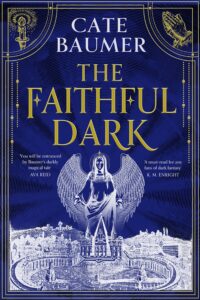
 The Faithful Dark by Cate Baumer
 Series: The Brilliant Soul #1
Genres: Adult, Fantasy, Dark Fantasy, Paranormal, Gothic, LGBTQ+
Published by Hodderscape on February 18, 2026
Format: Hardcover, Special Edition
Pages: 416


Source: Goldsboro Books
This is the city of miracles, but not everything miraculous is good.
In a holy walled city where sin and sanctity are revealed through touch, Csilla - a girl born without a soul - is worth little to the Church that raised her. But when a series of murders corrodes the faithful magic that keep the city safe, the Church elders see a use for her she can assassinate their prime suspect, a heretic with divine heritage, without risking the stain of sin.
The heretic, however, makes Csilla a clear his name by helping him catch the real killer, and he'll use his angelic gifts to grant her very own soul. Meanwhile, ruthless Ilan, desperate to earn back his position as Church Inquisitor, sees the case as his chance at he'll bring in the murderer - or, failing that, Csilla and the heretic - and regain his title.
But as the death toll rises, and their hunt pits them against the all-powerful and callous Faith, Csilla finds herself torn. Will her salvation come at the cost of everything she believes in?
Set in a gothic and snowy city where its citizens put their trust in the church to protect them from dark forces held at bay, their faith is put to the test when a series of mysterious murders occurs. As the holy wards and seal appear to weaken, murder victims are found, and unrest within the city grows, the head inquisitor, a blessed izir, and a selfless church caregiver without a soul work to discover who is to blame for these seemingly unrelated disturbances. The first book of a planned duology also serving as Cate Baumer’s full length traditional published novel debut, the Faithful Dark is a tense and atmospheric dark fantasy book that features highly relevant themes that touch on faith, heresy, testing one’s loyalties, and what it really means to be blessed.
Two of the most important elements when it comes to dark fantasy stories for me are the book’s sense of tone and sufficient world-building to ensure the stakes are set high. When it comes to ambiance and style, the Faithful Dark is a beast of a novel. Baumer’s fictional walled city of Silgard appears to be loosely inspired by a more urbanized version of the Vatican cast under the perpetual chilling frost of winter. Already featuring a strong gothic aesthetic, the book simply oozes atmosphere from every darkened street, hallway, basilica, and more. While never explicitly described, the focal church and holy reverence share the same visual grandeur (or horror) as the Catholic church which naturally lends itself to being quite hallowed and haunting. With a title like the Faithful Dark, it’s impossible not to have some sort of expectation for darkened churchcore and Baumer certainly delivers on it!
Narratively, the book contains a strong set of interconnected storylines that are all loosely connected to church’s dwindling support both in terms of holy power as well as popular opinion. As the head inquisitor of the church, Ilan is responsible for stopping the killer in Silgard who has been murdering citizens under unusual circumstances and leaving no witnesses. The blessed Izir and descendent of angels Mihaly has returned to Silgard with beliefs and opinions that the church views as heresy, with his own unknown motive in Silgard. The wards of the city are strained and the once brilliantly shining seal locked away in the underground depths of the church is tarnished and faded. And at the heart of all of it is a humble caregiving worker Csilla, an orphan the church took in and found abandoned without a soul. Over the course of its four-hundred-page run, the Faithful Dark pulls threads and clues from each of these different storylines and weaves together to form a mysterious and tense story perfect for readers looking for a dark gothic, Catholic-inspired tale.
While not considered a religious book per se given that the church is never named or connected to any real-world religion, the Faithful Dark features relevant thematic points that are highly relevant in today’s society. Dominated by the blessed Incarnate who is believed to receive the words from the holy angels, this individual’s word is treated as God, unquestioned and followed. Yet despite this person’s power, they are absent from Silgard in a tumultuous period when they’re needed the most, when faith and belief in the church is at an all-time low. In Baumer’s world, the holy angels have vacated and left the world, leaving trace elements of their power which is dwindling. As the dark forces spread outside of Silgard while the more bodies turn up within, the anger, fear and frustration with the church’s lack of communication spurs civil unrest that spreads much like the diseases and death raging outside of the city walls. Closely mirroring events in many real-world scenarios, the church responds through oppression, torturing citizens for answers, and further taxing the poor. Despite having different roles and relations to the church, all three of the book’s main characters see their faith in the church tested, no longer blindly following the words when it appears to contradict its own principles and values.
Despite having a great plot overall and compelling storylines, I found the pacing of this book to be a bit uneven. I was captivated by the amazing gothic and tense vibes of the first hundred pages, especially when it was focused on the paranormal murder mystery, subsequent investigations, and Mihaly’s arrival as a magical angel descendant posing alternative beliefs to the church’s traditional doctrine. After an excellent 5-star start, the story began to drag for me during its middle section where the focus shifts to Csilla’s lack of a soul, Mihaly’s interest in her, and events covering his past. While these points are integral to the book’s overall plot due to their interwoven nature, I found these chapters to be much less interesting than the earlier chapters which felt slower and almost irrelevant in the moment. Having finished the book, I feel like this is mostly to do this section lacking the haunting and atmospheric approach that was so strong earlier; there’s definitely potential given the presence of ghosts, dark magic, and unknown beings around, but it didn’t quite have the same gravity for me. I also found Mihaly as a character, particularly his motivations and backstory, to be a lot less interesting compared to Csilla and Ilan, and despite having respectable time and effort spent exploring the mysterious and affluent student Evie, this whole section felt comparatively weak which is unfortunate given it takes up so much of the book’s length.
What also doesn’t help the pacing is that world-building is frequently incorporated here and there in areas that break up the flow of the story or are introduced too late in the book. Despite the early chapters being interesting, I often found the world, church organization, and external politics outside of Silgard to be confusing due to a lack of information and context. The world-building is respectable given the scale and scope of the story, but its placement keeps the reader in the dark (pun intended) early on in a confusing manner rather than a mysterious one; I often got the Incarnate and the Izir titles mixed up early-on and details about the angels leaving, their powers absent, and the seal felt quite muddy until far into the book. Much of the world-building details are elaborated and explored later during the mid-section which further slows down the pacing. I’m not familiar with the indie version of this book that was since edited and expanded on for its traditional publication by Hodderscape, but the lengthening of the story may have also played a role with the drop in pacing. Fortunately, the last hundred pages pick up substantially where all of the different narrative elements and pieces start to click into place and the book ends on a very compelling to be continued note for part two of the duology. I just wish the story could’ve sustained the intensity and maybe focused more on the dark murders/church oppression/diminishing powers which felt compelling compared to the soul/dark magic/macabre elements that seemed to slow the story down.
Another area where I felt a bit mixed on was the character relationships and light romantic elements to the story. Presented from dual POV’s of Csilla and Ilan respectively, both characters had distinctive tones and internalized thoughts, one empathetic and caring, the other hardened and logical. While both characters are presented on opposite ends of the theological spectrum, neither are black and white, Csilla repeatedly showing quiet determination and strength and Ilan being a skeptic and a non-believer hoping to be proven wrong. In addition to having interesting dynamics, the Faithful Dark also features great queer representation with Ilan a trans man (a cold and intimidating one at that which is relatively rare in queer SFF books) and Mihaly suggested to be something undefined (bi/pan? Or a casual flirt). I also appreciated that although the book has queer characters, their identities do not heavily affect the story’s trajectory or purpose and are simply part of their characterizations. While this book is described as a literary fantasy book and not a romantasy or fantasy romance, I also felt a bit mixed on the romantic chemistry or slow burn interest. Granted things can change in the second book given discussions around resurrection, soul transference, and the like, but I felt like two characters who are not coupled to have better chemistry and romantic tension than two that were, which was an amusing and odd takeaway. It’s not a major issue considering the plot and theological exploration are the primary focus of the story rather than romance, but it’s worth noting for readers to go in with realistic expectations; this is a book of dark mysterious plot, not a dark or church-set romance.
Wonderfully atmospheric, well-crafted and written, not to mention having a full gothic and wintery aesthetic, the Faithful Dark is a solid dark fantasy book. Its multiple narrative elements are compelling heightened by Baumer’s sophisticated prose that can be quite dramatic at times. Unfortunately, not every character or fantasy storyline is quite as successful as the described murder mystery premise and though the world-building elements are strong, the presentation and placement doesn’t feel quite as effective as it could’ve been. However, these are relatively minor nitpicks in an otherwise polished and strong start for a duology. For those interested in holy church politics, blind belief vs heresy, and fantasy of the angelic/demonology flavor, the Faithful Dark is a great read!
Note: Received via Goldboro GSFF / Fellowship Feb 2026 pick.