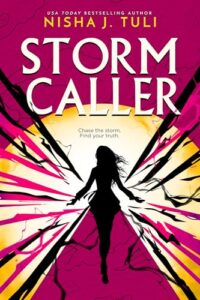
 Storm Caller by Nisha J. Tuli
 Series: Storm Breaker #2
Genres: Dystopian, Fantasy, Romantasy, New Adult, Post-Apocalyptic, Science Fiction, Young Adult
Published by Entangled: Mayhem Books on August 31, 2026
Format: ARC, eBook
Pages: 476


Source: Netgalley
Poet Graves has only ever wanted to be free. But no matter where she turns, she’s held captive―by a power she doesn’t understand, a truth she no longer believes in, and a love she can’t deny.
As Poet is drawn further into Rook's world, his secrets force her to question who she can trust. But when friends turn into enemies, enemies prove to be allies, and the place that was once a safe harbor is revealed as the eye of the storm, Poet's only choice is to fight for what she believes in.
When New Manhattan's darkest secrets refuse to stay hidden, the cause Poet and Rook fight for will be called into question. The answers are out there…and they could destroy everything.
Don’t miss the thrilling continuation to a thrilling upper YA romantasy by Nisha J. Tuli, where Divergent meets The Cruel Prince in a glittering, storm-wrecked Manhattan where the elite rule through legacy―and one forbidden romance could tear it all apart.
This review is based on a complimentary Advanced Reader Copy provided by Entangled: Mayhem Books.
Part two of Nisha J. Tuli’s Storm Breaker series, Storm Caller picks up after the first book’s high‑energy and cliffhanger ending. Featuring more overt dystopian elements, this book leans away from the typical academy setting and training arc, instead focusing on heavy world‑building that substantially expands the scope of the story far beyond New Manhattan. While this novel continues the signature storm motif and builds on the first book’s dystopian elements, it can unfortunately feel less balanced and lacking notable progression, giving it a transitional and somewhat underwhelming feel in addition to having a more juvenile tone.
Following Poet’s escape through the tunnels with Rook, Storm Caller sees her outside New Manhattan and into The Wastes. While the first book largely consists of a traditional academy training arc common in YA books, this one switches up the formula and focuses on expanding the world outside the protected city. As the second book in a now‑planned trilogy, it carries much of the burden of expanding the lore: life and culture in The Wastes, the history and conflicts with New Manhattan, General Sol’s spark‑channeling ability, and exploration of the Keeper condition plaguing citizens.
Caught up in conflicting groups and power struggles, Poet and Rook’s chemistry continues to be one of the series’ strengths, while her trust is tested when numerous secrets and hidden agendas come to light. After the first book’s storylines involving Poet’s family power, status, and Shield politics, this one focuses on Rook’s background and life. The contrast between their families, values, and sense of home provides great narrative conflict beyond miscommunication, though the book uses that trope more than ideal. The change of setting also provides strong opportunities for scenic visuals. Whether it’s the landscape of The Wastes, settlements, farmland, or valleys, Tuli’s visuals are a highlight. Similar to Storm Breaker, the sensory descriptions of energy strikes, sparks, and storm ambiance continue to be a treat.
Given the story now includes several communities, political organizations, and underground groups, a good portion of this book consists of secret reveals, societal history, and general lore information. While the ideas themselves are quite solid, they’re conveyed through lengthy and repetitive conversations between characters. Nearly every new discovery follows the formula of a character needing to come clean and confess their secrets, Poet demanding they “tell me everything,” and the character delivering a dramatic explanation followed by a request for help. The book spends a lot of time telling the reader what’s happening rather than showing it. Later scenes will follow with Poet telling other characters everything which can feel unnecessary considering not every character plays a major role in a given confrontation in addition to further making her look naïve as some of them should not be trusted. While Storm Caller has brief moments of good action toward the end, they’re few and far between. As much as maybe 80% of the book consists of characters talking in place, lacking the variation and mix of storytelling developments of the first book. While the book isn’t necessarily slow‑paced, the story can feel like it’s dragging due to excessive world‑building and romance that feels repetitive, coupled with limited narrative progression. This is particularly disappointing compared to the first book, which had an excellent balance of action, character development, romance, and dystopian lore.
The overall tone and character writing also feel considerably more juvenile and YA compared to the first book, which had crossover appeal as a new adult novel. Poet’s narration feels more immature and surface‑level, and her decision‑making feels noticeably more spastic and questionable compared to her resourcefulness previously (thankfully though, this book does not have the CW Gossip/Mean Girls dialogue present at the beginning of Storm Breaker). Repeated betrayals and poor judgement make her appear unintelligent, and the chosen‑one trope is used more heavily despite her limited understanding of the Shield, the Keepers, and external communities. It stretches believability that a strike task force, a secret rebellion organization, and powerful political figures would rely on a second‑year academy student’s expertise over years of established knowledge and experiences. Her internal thoughts also tend to slow the pacing without adding much to the story, and the romance sometimes feeling like it’s just going through the motions. The dialogue is also notably more stilted and awkward throughout this book, where it was only an occasional issue in the first one. Lines like “I’m Justin, the youngest of the Althira siblings” feel unnatural and not how someone would introduce themselves, try saying that out loud. There’s also an issue where many of the supporting character’s dialogues seem age-inappropriate. Younger characters can sound too childish, while older adults sound overly dramatic and like teenagers. Villains and adult character motivations can seem quite basic while the explanations behind the dystopian system can feel underwhelming despite the overall ideas being good.
Largely serving as a transitional book in the series, Storm Caller is a bit of a mixed bag. While it covers crucial and necessary world‑building while leaning further into its dystopian elements, it lacks the engaging balance, consistent pacing, and appealing character work that made Storm Breaker so impressive and memorable for me. It also doesn’t feel like it progresses the story much, and the sparce narrative content seems stretched to fill its four‑hundred‑plus pages. When I originally ARC‑reviewed Storm Breaker, I believe the series was a planned duology. However, now it is being marketed and described as a trilogy. My suspicion is that the original draft may have been too lengthy to fit the typical YA novel format or there was a notable change in direction for the series. The near‑absence of the Shield’s houses and political structure, despite their prominence in book one, makes it almost seem like there wasn’t enough planning with the series outline or there was a pivot toward external groups and affiliations. The cliffhanger ending also left me mildly concerned with the series’ trajectory. However, despite these weaknesses, the world remains intriguing and the storm‑wielding elements continue to be exciting to read about. Although this book has a less polished and rushed feel, I’m still interested in seeing where the final installment takes the story and how Tuli plans to tie everything up!