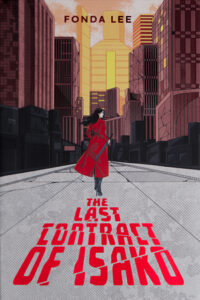
 The Last Contract of Isako by Fonda Lee
 Genres: Adult, AAPI, Noir, Science Fiction, Cyberpunk, Hard Sci-fi, Speculative Fiction
Published by Orbit on May 4, 2026
Format: Hardcover, Special Edition
Pages: 514


Source: Starbright
Get ready to be blown away by this searing standalone space opera where corporate samurai fight beneath merciless stars, and death is always a mere breath away.
Isako is a legendary swordswoman, but every legend has to come to an end. When her long-time client unexpectedly retires, she plans to follow--to walk out into the frozen wasteland of their planet with her head held high and her family enriched by her legacy. But when a competitor offers her a final mission, it's one she can't refuse. Soon, she's thrust deep into a world of corporate espionage, duty-bound duels, and shadowy secrets. What she uncovers will change humanity's existence in the stars forever.
The Last Contract of Isako is the space opera you didn't know you needed: corporate samurai... in space. This is the first adult science fiction novel from the award-winning author of Jade City.
Mixing together politically motivated corporate strategizing, samurai code of conduct, rigid society resource management, all set on a frozen and desolate planet, The Last Contract of Isako is a complex and mature story. One of the most anticipated SFF titles of the year as well as Fonda Lee’s scifi debut, this book is incredibly ambitious, featuring themes, character writing, progression, and an ending that is understated and restrained. This is not a book for those looking for heavy samurai action, futuristic cyberpunk visuals, or flashy space opera elements. But for readers that appreciate slow-burn investigative political thrillers and thoughtful reflections on aging and one’s mortality, The Last Contract of Isako does not disappoint.
In many ways beyond the age of its protagonist Isako, The Last Contract of Isako is the kind of mature book conceptualized and written by an established author confident and settled to take bigger and unexpected narrative swings. Although it is described as scifi space opera with a battle-worn samurai on a last mission where she may face death at every turn, this almost feels like an attempt by the publisher to market the book and make it appear far more mainstream than it really is, hence the disappointment highlighted in quite a few negative reviews. While the synopsis isn’t technically inaccurate if read black and white literally, it suggests an intense, combat-heavy narrative in space which is neither Lee’s style of writing nor the intent of Isako’s contract. While this book has great brief bursts of action and flashy scifi visuals, they are relatively few and far between.
So if the story isn’t about Isako using her samurai skills to slay enemies, what is this book about? The narrative is largely one that revolves around corporate strategizing, balancing of resources, and consequences of power and political succession. In this book, Atier contractors like Isako are not merely hired hitmen, although many are more than capable and willing to fulfill such roles. These contractors perform multiple roles as determined by their client which can include bodyguard protection, undercover espionage, manipulation of political and societal organizations, just to name a few. However, the best Atiers are those that are also proficient in the ways of strategizing and managing beneficial opportunities and relationships, providing direct advisory to their clients, costs of money or life be damned. The story is a complex one that follows the push and pull of corporate power and influence, Isako, her former apprentice Martim, and a past Atier partner being caught in the middle of it.
While slower and less hitman focused, the story at times can feel like a space colony take on John Wick that’s a slow burn investigative “thriller”, though I use the term apprehensively due to limited action, tone, and pacing. Isako’s last contract and task to prevent the nomination of a corporate CEO to the space colony’s governing board becomes far more complicated as she discovers the figure in question’s Atier Martim who she previously mentored has gone missing, having possessed damaging information on the cause of a past deadly disaster and inter-corporate war and branch-wide layoffs. The story develops slowly and can sometimes feel a bit dry and cold at times (more on that shortly), however an unexpected POV shift at the half-way mark quite literally turns the story on its head. Like Isako’s contract, the plot is far more ambitious and twisty than it initially seems and one that is best experienced blind free of any spoilers. As the reader progresses further into the second POV, the full scale of Lee’s narrative vision comes to light, and the story’s intensity and stakes steadily grow. Lee also rounds out the book with a bold ending that I know will not be to every reader’s taste (those that want plot and resolution to the colony’s future and the the succession of power will be disappointed) but is one that is quiet, understated, yet thematically grounded to Isako’s character journey. It is the mature type of ending a young author either in age or their career would likely never do and one that I have a lot of respect in Lee for writing.
Throughout the book, the story has consistent themes related to physical and mental pains of aging. Once one of the most skilled and respected Atiers nicknamed Quickblade for her speed and precision, Isako’s reflections on how time weathers away at people is effectively covered. Topics of one’s mortality are also covered not only due to presences of a condition called Gray’s Waste (a speculative mix of dementia, ALS, and wasting), but also via wageworkers system of retirement. On the frozen planet of Aquilo where limited resources of heat, water, and oxygen are in short supply, those retire or are laid off and given a literal sendoff where they are forced to walk into the desolate wasteland outside of protected city as they honorably succumb to the elements as their loved ones watch on in ceremony. As the city grows and the outer limits expand, their frozen remains are absorbed, their final resting places being memorialized as a fountain, building, or other point of interest. The rigidity of the city society, distribution of wages and resources, and hyper-efficient system even has light dystopian flavor on a closer look which results in an interesting reading experience when mixed with the Atier contract and roles; Edo period Samurai culture and bureaucrats to their daishō adapted as The Company and the required Atier Code of Conduct respectively.
While less colorful or overt than I think many readers are expecting, the book’s scifi elements are quite prominent and thoughtfully utilized. In a clever reverse twist of Earth’s environmental concerns and future, the planet of Aquilo is a frozen and desolate landscape devoid of an established atmosphere and greenhouse gases. Instead of reducing carbon emissions, the colony’s terraforming program works to increase emissions to warm the planet. Likewise, city locations that are overly heated and temperate are those of luxury and opulence compared to the poor areas that are cooler. Politics involve the power struggle between the terraforming corporations with programs designed for open relations in a conflict of self-sufficiency and autonomy vs attempts to reestablish communication with Earth and other colonies. Many of the scifi concepts are interesting reverse twists on common ideas, which give it a refreshingly different feel, not to mention more speculative in nature given their grounded and plausible roots vs more futuristic or neon-colored visuals. The sole element that earns the book its occasional cyberpunk designation is its recorpalization, the process of preserving an aging person’s consciousness as “jar brain”, connecting the living brain to a fully synthetic and artificial body and the implications that come with it. Though perhaps more subtle compared to other popular scifi novels, the ideas give the narrative a lot of interesting material to work with, hence the ambitious and twisty plot.
While the premise, concepts, and plot are strong and the corporate-political strategizing and deception excellent, the story’s pacing and and approach to its story likely won’t work for everyone. The story is a slow burn mystery that mixes scifi with thriller noir aspects and though it features great action, they’re fairly limited and used quite sparingly. This is a book that consists of unraveling intentions and theorizing future movements of key figures vs physically stepping in and slashing them with a blade. The bulk of the plot is also related to contractual obligations and corporate succession which can be gripping for certain readers and utterly dry for others. It also doesn’t help that while Lee’s prose is serviceable, it’s also very pedestrian and basic in nature. I try hard not to let it affect my scoring, but third-person present tense is my least favorite style of storytelling that often feels more restrictive and lacking in nuance and engagement, exacerbated by the lack of lyrical flair. For fans of Jade City, this is particularly notable given that series was presented in third-person past tense which has a different feel from this one. Additionally, for veteran scifi readers, it can sometimes feel like the book is rehashing familiar ideas and the story starts to drag until the full scope of the story is slowly revealed after the half-way point POV shift.
While the character development is objectively good, subjectively the delivery also likely won’t work for everyone. The book’s tone and character writing can both figuratively and literally be a bit cold where despite the grave and somber situations and subsequent repercussions, characters appear detached and vacant. Terminated employees are forced to honorably walk outside the city to their death, gray’s disease is a degenerative and terminal illness, recorpolization essentially kills the recipient’s body and essence of living in favor of extended life, and entire programs are eliminated on the whims of resourceful consolidation or redirection. Given the ages most of the characters are senior in age and weathered (except for Martim), many of the reactions are of grim acceptance but compassionate and emotional readers may find the recurring muted reactions frustrating and off-putting, some reviewers incorrectly attributing this to poor character writing. The honor-heavy adherence to the Code and withdrawn emotions are likely much more relatable to those familiar with traditional Asian culture and values. On top of that, Isako’s story of her last contract before her requested retirement is a powerful narrative and the book’s plot and ending are very well crafted around the character’s internal motif and last samurai sendoff. While it’s a respectful and bold choice for the story, the ending is one that I already know will sit poorly with quite a few readers that may find it disappointing, underwhelming, too open-ended after the intense narrative climax, or worse a creative mistake. It’s not to say that this book is only suited for older readers, but it’s one that requires a certain amount of patience and maturity.
Ambitiously plotted and refreshingly different mix of elements for the genre, The Last Contract of Isako is sophisticated and bold book that does what it sets out to do well. With complex and unpredictable corporate strategizing, political conflict, and contractual obligations, the story can be fascinating for those interested in a slow burn investigative narrative. Featuring an older veteran female protagonist and her combat-challenged protégé, the book’s somber themes and the restrained tone make this a unique scifi book best suited for mature readers that want something less adrenaline-fueled or flashy than others in the genre. It also tackles concepts and themes that are inherently very difficult to pull off which is why I’m more willing to forgive some of its rough aspects and mild pacing issues (I’m giving it a 5.0-star review on its ambition but if the content were less difficult to cover, it would’ve been more like a 4.0 – 4.5). This book was well-suited to my subjective tastes and is one that I found impressive but is also one that I recommend with reservations. Arguably the biggest consideration and hurdle with this book is the marketing and expectation for high-intensity samurai action or scifi flavor that’s more fantasy than science; it isn’t necessarily an incorrect synopsis but one that can be quite misleading. Its measured pacing, muted character work, and simple writing style are also common factors that contribute to this book potentially being quite dry and lackluster for some. However, for those that are patient or interested in battles fought theoretically in the corporate office rather than directly in the streets, The Last Contract of Isako is solid read and a successful traditional scifi debut for Fonda Lee.