
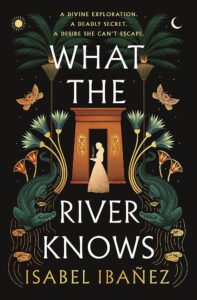
 What the River Knows by Isabel Ibañez
 Series: Secrets of the Nile #1
Genres: Adventure, Fantasy, Fantasy Romance, Historical Fantasy, Low Fantasy, Historical Fiction
Published by Hodderscape on October 31, 2023
Format: Hardcover, Special Edition
Pages: 416


Source: Goldsboro Books
Bolivian-Argentinian Inez Olivera belongs to the glittering upper society of nineteenth century Buenos Aires, and like the rest of the world, the town is steeped in old world magic that's been largely left behind or forgotten. Inez has everything a girl might want, except for the one thing she yearns the most: her globetrotting parents-who frequently leave her behind.
When she receives word of their tragic deaths, Inez inherits their massive fortune and a mysterious guardian, an archeologist in partnership with his Egyptian brother-in-law. Yearning for answers, Inez sails to Cairo, bringing her sketch pads and a golden ring her father sent to her for safekeeping before he died. But upon her arrival, the old world magic tethered to the ring pulls her down a path where she soon discovers there's more to her parent's disappearance than what her guardian led her to believe.
With her guardian's infuriatingly handsome assistant thwarting her at every turn, Inez must rely on ancient magic to uncover the truth about her parent's disappearance-or risk becoming a pawn in a larger game that will kill her.
18th century Egyptian history layered with myths surrounding Cleopatra, Isabel Ibañez’s What the River Knows is part one of her YA historical fantasy duology Secrets of the Nile. Featuring a great balance of mystery storylines, familial relations, romantic banter, and light fantasy elements based on magical objects, this book hits all the right marks and is a well‑crafted YA read. With a solid start and appealing main characters, this book is really fun despite some pacing issues in its back half and a sequel that ultimately does this book no favors.
Intended to be a historical fiction book with a fantasy romance story, easily the strongest element of the book for me is the way it successfully captures the sense of adventure reminiscent of stories like Indiana Jones despite having little action. From the moment Inez receives the unfortunate letter in Argentina, the story maintains this great motif of exploration. Whether Inez is exploring cities in Egypt, hiding as a stowaway on a river barge, visiting historic sites, or simply on the run while evading the peeved and exasperated Whitford Hayes, the story has a genuine adventurous spark that makes the book so fun to read. The tone also benefits from the book’s compelling historical fiction elements revolving around Cleopatra, the British occupation of Egypt, and the smuggling of historic artifacts on the black market under corrupt political figures.
Following Inez’s journey to Egypt and her search for clues surrounding her parents’ mysterious deaths, the story has a strong narrative hook that is further strengthened by the book’s narrative and stylistic choices that make it an ideal YA read. Inez is a wonderful main character whose internal character logic and narration are very appropriate for YA readership, with many of her struggles, worries, and excitement being relatable not only for young adults but also older folks who are still young at heart. Going hand-in-hand with the feeling of adventure is Inez’s sense of wonder at the bustle and excitement of not only being in a place her parents had loved, but also being on her own and free from her family’s restrictive rules and expectations. While some may find her stubbornness and impulsive tendencies tiring or frustrating, Ibañez balances her character’s resilience with equal amounts of resourcefulness and reflection, helping her avoid coming off as bratty or foolish in her decision-making process.
Complimenting her character perfectly is her uncle’s assistant Whitford Hayes. An ex-British soldier turned jack-of-all-trades rogue keeper, his alternating perpetual states of exasperation and baffled bemusement are great. Although Inez is the heart and soul of the book, the story is consistently more entertaining whenever she shares the page with Whit. Their platonic‑turned‑romantic chemistry is pitched perfectly, a wonderful mix of excellent comedic banter, light and dark contrast, and unlikely camaraderie. Early chapters that see Whit failing to restrain Inez and unwillingly becoming part of her grand plans to escape from her uncle’s attempts to send her back home are consistently funny, the early chapters being a joy to read. As the story progresses, so does their relationship, which is well-handled and on brand for the YA designation. Importantly, while the romance is a large part of the book, it never feels like it gets in the way or dominates the story’s main mystery storylines and instead complements them well.
While Ibañez’s prose is fairly casual and straightforward for YA readership, another highlight is her consistently strong visuals and sensory descriptions. Particularly the early cities like Alexandria and Cairo feel alive with vibrant ambiance and colorful energy. The arc of the book set in Cairo is especially impressive as Ibañez is able to distinguish each area and locale in the city through unique tones, such as the Khan El-Khalili Bazaar, Shepherd’s Hotel, and the port. The descriptions and explorations of the ancient island of Philae are also well done, Inez and Whit’s explorations feeling like a cross between Indiana Jones and National Treasure. It’s clear that Ibañez loves and has done the research to back up this book’s historical roots rather than throwing out a vague portrayal of the time period and vibe. And for the foodies out there, this is a book full of delectable and varied food and beverage items.
While the book has a great premise and a strong start, unfortunately there are notable parts where the story starts to drag and seemingly loses its direction. Once Uncle Tio’s expedition group bound for Philae departs from Cairo, the story starts to get murky, and the narrative gets pulled in different directions. What the River Knows has a fairly slow pace that’s forgivable early due to its strong visuals and compelling sense of adventure, but both noticeably wane from when the group is on the river boat and onward. The story adds several new characters that are not particularly interesting while Inez and Whit have very limited and strained interactions, which up to this point is the book’s secret sauce. Once the expedition reaches the island of Philae, this arc unfortunately feels a bit underwhelming and lackluster. The exploration and sensory descriptions are still good, but it feels like there’s not enough story to fill out the back half of the book, let alone justify the duology length. Then suddenly, out of nowhere, the last fifty pages crank the intensity and pace up to an 11, which is both jarring and chaotically messy; a sentiment that seems to be a recurring drawback of Ibañez’s plotting and a major issue I had with her adult novel debut Graceless Heart. Not only is it tonally different, but the ending can also feel shockingly violent compared to how relaxed the rest of the story appears; sensitive readers should check the trigger warnings or even spoilers. Additionally, the magic around artifacts, Cleopatra’s lore, and really all of the fantasy elements take a complete backseat and provide very few answers to the book’s long-running mysteries. The abrupt shift in pacing and direction toward familial drama and betrayal is also confusing considering the book had the entire middle section to work with, which had relatively slow progression and a lack of substance.
Another weak spot of this book is the character development and writing of the supporting side characters. This book has a fairly large cast given its mix of original characters with real historical figures, but many of them feel like they don’t have enough of an introduction or spotlight for the reader to remember who’s who; the sequel somewhat fixes this issue by providing a glossary of the characters and their importance or roles. This is most notable during the Cairo arcs with the various key political figures involved with excavation permits, the historical preservation society, and black-market artifact smuggling rings. This also comes up again while on the Nile River when weapons expert Charles Fincastle and his daughter Isadora are introduced, on top of Uncle Tio’s expedition partner Abdullah Salah and the deckhand Kareem. Kareem in particular feels like a role that could’ve been absorbed by other characters, while several of the key historical figures don’t contribute much to the story. Isadora also can feel like a missed opportunity here, especially considering her importance and role in the sequel. To the book’s credit, some of these characters play bigger parts in the second book, but they could’ve felt more notable with adjustments to the book’s plotting or by giving each character more depth rather than a single prominent personality trait.
On an important side note, when I read books that are part of a series, I typically write my reviews upon completion of each individual book rather than writing them after finishing all of them. However, I made a conscious exception with this one as I had not only had both books in-hand as well as having heard some other readers expressing their disappointment and frustration with the sequel. The abrupt shift at the end of this book further raised my suspicions of where the series would go. While I won’t go into much detail in this review (my review for Where the Library Hides will be posted shortly), it’s worth noting how disappointing and misguided I found the sequel to be. The specific highlights and aspects I loved about What the River Knows such as Inez and Whit’s chemistry, the sense of adventure, and distinctive ambiance, are thrown out the window. Worse, the historical fiction and light fantasy elements present in this book’s premise are entirely absent until the last quarter of the sequel, the mystery and intrigue replaced by endless romantic miscommunication, betrayals, and family conflict. On top of that, the ending is almost comical in how poorly the characters are written and a crucial plot twist just before its conclusion made me genuinely angry at the series for how cheap and poorly it was done which rarely happens for me. I found the sequel’s story and direction to be such a letdown that it inadvertently tarnished my opinion of this first book, negatively reversing my what would’ve been a positive recommendation for the series. I originally rated this book 4.0 stars which was since knocked down to 3.5, further rounded down to 3 stars on Goodreads. While this book is still generally quite good, at times great, it nonetheless is a book I now caution for potential readers, particularly those picking it up specifically for its fantasy genre tag.
With a great premise, intriguing historical fantasy elements, and a strong awareness of YA readership appeal, What the River Knows is a fun book that gets most of it right. While its pacing and execution can be uneven and inconsistent at times, its great sense of adventure and the character dynamics between Inez and Whit are almost good enough to carry the book through whatever the story is doing, as well as when its lacking. Unfortunately, its back half loses steam the further the story progresses while the ending and its sequel subjectively dismantle many of the good things its first half does so well. At one point about 150 pages in, I had this book’s rating as high as 4.5 to 5.0 stars, which makes it all the more disappointing that its narrative choices progressively spun the story in a less interesting and perplexing direction. While I’d like to recommend this book based on how well it works as a young adult / new adult read up until the last fifty pages, its dramatic and questionable cliffhanger ending means that it can’t be read on its own and is therefore a package deal with its misguided sequel, which only really appeals to those looking for a miscommunication-heavy, angst-filled romance and drama read. For fantasy readers or those that have a low tolerance for manufactured conflict, perhaps it’s best to avoid this duology all together.