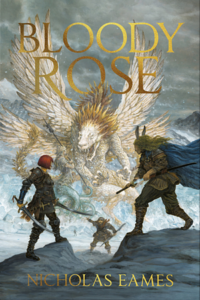
 Bloody Rose by Nicholas Eames
 Series: The Band #2
Genres: Adult, Adventure, Fantasy, Dark Fantasy, Epic Fantasy, High Fantasy, LGBTQ+
Published by Orbit on August 27, 2018
Format: Hardcover, Special Edition
Pages: 515


Source: The Broken Binding
Live fast, die young.
Tam Hashford is tired of working at her local pub, slinging drinks for world-famous mercenaries and listening to the bards sing of adventure and glory in the world beyond her sleepy hometown.
When the biggest mercenary band of all rolls into town, led by the infamous Bloody Rose, Tam jumps at the chance to sign on as their bard. It's adventure she wants - and adventure she gets as the crew embark on a quest that will end in one of two glory or death.
It's time to take a walk on the wyld side.
Like its namesake character, Bloody Rose by Nicholas Eames is a book that has big shoes to fill after its predecessor’s bombastic breakout. Rather than recycling or retreading familiar beats, this book is an effective and smart sequel that reflects and contrasts Saga’s adventures and fame, telling its own story that’s more serious, mature, and thematically rich while still maintaining the spirit of the first book. Though some readers may find it less funny or entertaining initially, Bloody Rose is a well-rounded high fantasy adventure that successfully builds off the first book’s world-building, lore and band culture.
As far as debuts go, Eames’s Kings of the Wyld is a textbook example of making a statement, a book with a lot of personality and great humor. With the way the story ends, it’s clear a sequel was planned, though it would be facing high expectations. With such a large looming shadow behind it, Bloody Rose is an interesting and intelligently crafted sequel meant to be a companion piece to the first book rather than an attempt to outdo or rehash the same narrative formula.
Set six years after the first book’s ending, this story follows the modest and unassuming Tam Hashford, who unexpectedly ends up accompanying the famed mercenary Rose and her band Fable on a contract assignment to the north. Right off the bat, Bloody Rose has a noticeably different tone which is more grounded and mellow compared to the first book, which could sometimes feel unhinged in a negative way. While still channeling roguish energy, this book plays its story straighter and more seriously despite its initially vaguer premise.
One of the most notable aspects of this book is its deeper and more prominent themes, purposefully integrated into the story and contrasting with elements from the first book. Where Clay Cooper and Saga were an old-school band fighting monsters across the land, Rose and Fable follow a new‑generation approach: touring city arenas with prescheduled fights in controlled environments for entertainment and profit. Not only does this pivot away from the original in-lore purpose of Bands to aid those in need but it also introduces new moral discussions around the entrapment and slaughtering of “monsters” for sport in packed arenas. Whether they’re bred in captivity, tortured while enslaved, drugged to ensure they are killed per the performance schedule, the dark side of the sport becomes evident the more Fable tours, an uncomfortable moral dilemma for both Tam and Rose. Akin to performers or actors in a circuit, the lack of experience and skill is also a deadly shortcoming for many modern bands venturing out on the battlefield for the first time against an invading horde of monsters, for the first time being in a situation outside of their control.
While the first book was largely structured around the Saga band members and their past glory, this one is much more focused on the important role of the bard, something the first book glossed over as it was a running joke about how Saga was inept at keeping their bard alive. The one responsible for recording and sharing their adventures and tales via music and poetry, a battle or conquest of glory means nothing if there’s no one around to witness and share it. Besides the obvious difference of following a bard as the main character vs the first book that notably had no bard until nearly two thirds of the way in, the increased importance of the role is also nicely connected to another great theme of the storytelling and perspective. Songs of legends are composed by the victors and the ones reciting the tale, but what about those unable to share their stories or perspectives? Are bands really making the land a safer and more prosperous place or are they really monsters themselves, killing everything they see that’s not human for sport and entertainment. Also related is the stigmatization of those who are not human exhibited by both Freecloud and Roderick to notably different degrees, one being spurned because of his kind’s association with past conflicts while the other simply being deemed non-human slop. Throughout the story, all of these conflicting thoughts linger in the back of Tam’s mind as she discovers the uglier side to touring and being a mercenary in addition to her confusion surrounding Rose’s aloof and unusual decision as the leader. Her preconceptions and reflections are tested when Fable’s final contract is revealed to have unforeseen repercussions and a connection to the threatening hoard invading from the west.
As far as characters are concerned, the biggest change is that the main character Tam is not a bandmember or mercenary but is simply an ordinary young woman with parents who were not so ordinary in their younger days. While Tam is a grounded and relatively calm band member similar to Clay Cooper in Kings of the Wyld, her being a witness on the sidelines gives the story a uniquely different perspective vs one where the protagonist is in the heat of fight, say as if the story were written from Rose’s perspective instead. Tam herself gets into quite a bit of combat whether willingly or not, ensuring there’s no shortage of action, but it still gives the story a different spin. While some readers may find her character to be a bit bland and underwhelming, which is by purposeful design, her serving as the main character is a clever and surprisingly effective creative choice on Eames’s part.
And yet here they were: at the cold edge of the world- each of them vying to be worthy of one another, to protect one another, to prove themselves a part of something to which they already, irrevocably belonged.
And me? Tam mused. I’m just the idiot that followed them here.
As the outsider and newest member of Fable, she serves as a great stand-in for the reader who has only briefly been introduced to Rose and Freecloud at the end of Kings of the Wyld and is new to Fable’s band dynamics. Her mother being a bard while her father discouraging her from being a mercenary are interesting storylines that are quite a different flavor from the first book that serve as a great foundation for her character to develop from, some direct comparisons could be made between Tam and Clay Cooper’s daughter Tally. Always told to watch from the sidelines as a bard, her desire to help others against her better judgement is a recurring sentiment throughout the book that culminates in one of the book’s most memorable character moments near the end of the book. One area I personally found underwhelming in the first book is the lack of decisive ah-hah moments or decisive moments of realization which Bloody Rose is far more successful with, a contributing factor to its more satisfying and tight back half.
The rest of Fable’s members are quite varied in terms of personality and abilities, setting themselves apart from Saga. While Saga’s members were largely physical fighters with the exception of the mage Moog, this band instead only has one straightforward mercenary which is Rose. Freecloud possesses similar heightened abilities as Lastleaf, the inkwitch Cura uses tattoo-based summoned beings for combat, and Brune is a shapeshifting shaman. With a pretty diverse set of abilities, Bloody Rose features excellent action scenes that are creatively choreographed, more visual, and all-around a step up compared to those in the first book which were no slouch to begin with. While familiar with each other, the members of Fable have a very different dynamic from Saga given they haven’t been together as long and are much younger than their older counterparts. While Saga could feel like partying fraternity full of bromance, Fable is more subdued given its mix-gender composition and possibly Eames looking to address the testosterone-heavy feel some readers criticized. The humor has a noticeably different approach that is still roguish but less crude and a tough wittier. Unlike Saga’s previous booker who was a POS who had his end coming, Fable’s booker Roderick is in the trenches with them and serves as this book’s comic relief character. While Kings of the Wyld had pretty good representation considering it was working with an all-male group of main characters, Bloody Rose fares slightly better given it’s led by two main female characters. Tam is also a rare high fantasy protagonist written by a male author who is a lesbian in addition to Cura who is pan, earning the book’s queer fantasy designation. Note, while there is a tiny bit of romance, this is by no means a fantasy romance or romantasy book. While this book’s characters may not seem as charming or fun as the previous book, the character development and writing as a whole is much more nuanced and mature.
Although the story follows a different band from the first book, it’s loaded with cameo appearances by characters big or small that reward returning readers. While most readers would expect Saga members to return in this book given that Rose is their leader Gabe’s daughter plus the other members all being her uncles, the book brings back a wide host of characters big and small, my personal favorite being the Jain who continues to be a scene-stealer. The story really hits its stride halfway through where Bloody Rose leans heavier into its sequel content and the reintroduction of Clay, Gabe and Moog as well as the mental implications of Rose’s past.
While this book is largely an all-around improvement in terms of writing quality and ambition, this is a sequel that may not necessarily satisfy every fan of the first book. Kings of the Wyld has such a wild and fantasy bro style of storytelling in addition to having very masculine and crude humor that is an interesting juxtaposition against its quite grave premise, a trait that sets itself apart in the high/dark fantasy genre. While Bloody Rose is also quite comedic at times and embodies a similar spirit, it often feels less fun overall. The story has a darker and more serious tone that suits the higher stakes and reputation of the book’s villain better, but returning readers that are hoping this book will hit that same wild and chaotic experience will likely be disappointed. While Roderick is very humorous, the members of Fable aren’t quite as silly as Saga’s members, which isn’t necessarily a bad thing, but may feel less memorable by comparison. The group chemistry can also feel a bit lacking or hollow until the story gets to each new character’s origin story and history; apart from Rose who was previously introduced, the book subjectively doesn’t do a great job at selling Fable’s likability or appeal compared to Saga’s, often stating their fame and popularity rather than demonstrating or actively showing it.
While Rose and Tam are appealing characters, I think that Cura and Roderick are both underutilized in the book. Cura’s characterization and backstory involving her family, the ink on her skin, and the externalization of internal fears are great narrative material that could’ve been pushed further as well as Roderick’s sense of belonging in Fable in a world that only sees and scorns him for his horns and fur. Freecloud also can feel like a missed opportunity given his background and connection to Rose that’s often alluded to but rarely covered in detail. While I understand he’s meant to be the voice of reason and the pragmatic member of the band, he can seem bland and boring as a character made worse by his character development and complexities only being revealed at the very end of the book. His romance and relationship with Rose are also quite lackluster due to how briefly their meeting and relationship are described in a very casual and off-handed manner. This is a notable issue as many of the tense, grave scenes or conflict towards the end of the book heavily hinge on their connection and love for each other that the reader almost has to kind of assume and take the book’s word for it given how little time or substance they’re given. As a veteran reader of classic style fantasy books who has only started reading more fantasy romance and romantasy books in recent years, I never thought I would find myself wishing for more romance while writing a high fantasy book review.
The other potential drawback is the sense of pacing and interest. After an effective and interesting introduction to Tam’s character and her invitation to join Fable, the story starts to drag for much of the first half of the book. Having recently read Kings of the Wyld a month ago, I believe the main issue has to do with this book’s premise and lack of a strong narrative hook. While the first book had a very clear call to action of Gabe recruiting Clay and rounding up the band to rescue Rose from Castia, this one’s premise is vaguer. Rose and the Fable embark on a cross-country adventure and tour, but it feels like the story doesn’t really have a clear direction, the group simply moving from city to city with seemingly random, aimless encounters; a similar issue in Kings of the Wyld’s Heartwyld arc. An end destination exists via Rose’s last contract up north, but it can feel underwhelming. In hindsight, this makes sense narratively as it demonstrates to the reader how pointless and performative the band’s touring is, the reading experience likely isn’t intended to feel that lackluster. The first half of the book also spends time establishing the previously discussed themes about drugging monsters or who the monsters are based on perception, but I think the book could’ve gone further with these discussions to offset the story appearing less fun on a surface level. The saving grace is that its back-half is plotted very well and the group chemistry between Fable members suddenly just clicks after each character’s backstory is covered. With Saga members returning, excellent action scenes, and a very elaborate final battle of epic scale, this book gets better and better as it goes along and ends on a very high note which leaves a strong impression. This is the opposite of Kings of the Wyld where I felt its first half was more exciting and compelling than its back half where it somewhat lost its way and its final battle being merely serviceable, which isn’t a great impression to end on.
As a sequel and an intentional part two after the first book’s somewhat “to be continued” ending, Bloody Rose is largely a successful and satisfying read. Rather than trying to repeat the same formula of Kings of the Wyld, this book uses the reader’s knowledge of the first book’s story and uses it for greater thematic depth. For readers that found the first book to be unhinged and fantasy bro heavy, this one is much more balanced, nuanced, and features all-around stronger narrative choices and writing. While its slightly more serious tone and new characters inadvertently can make this story feel less fun or charming particularly in the first half, it’s by no means poor and at worst, can merely feel like a competent if not generic high fantasy book. However, this story is one that rewards patient readers with an excellent back half and makes any of the previous slower sections more forgivable, ending the book on a much grander and satisfying note compared to the first book. I personally had no opinion of this series prior to reading it as it was originally published during my extended hiatus from reading, but I’m glad to have picked them up courtesy of The Broken Binding’s Fantasy subscription and recommend them as an easy-to-read fantasy adventure focused on family values and group camaraderie.
Note: While a third book was announced to be in the works, as of eight years later there’s still no updates from Eames or signs of it being close to publication which effectively makes this series a duology. Even if Outlaw Empire never comes out, this book ends with a decisive concluding note that fully works should it end up also having to function as the series conclusion. I for one would like to read more given the notable improvement in Eames’s writing chops and storytelling, but do not hesitate giving this series a try even though some platforms for book databases list this series as ongoing or incomplete.