
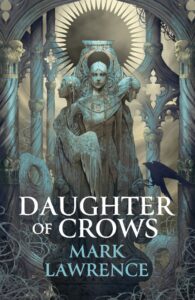
 Daughter of Crows by Mark Lawrence
 Series: The Academy of Kindness #1
Genres: Adult, Fantasy, Dark Academia, Dark Fantasy, Epic Fantasy, Magic, Paranormal, Gothic
Published by Harper Voyager on March 23, 2026
Format: Hardcover, Special Edition
Pages: 375


Source: The Broken Binding
Set a thief to catch a thief. Set a monster to punish monsters.
 The Academy of Kindness exists to create agents of retribution, cast in the image of the Furies—known as the kindly ones—against whom even the gods hesitate to stand. Each year a hundred girls are sold to the Academy. Ten years later only three will emerge.
 The Academy’s halls run with blood. The few that survive its decade-long nightmare have been forged on the sands of the Wound Garden. They have learned ancient secrets amid the necrotic fumes of the Bone Garden. They leave its gates as avatars of vengeance, bound to uphold the oldest of laws.
 Only the most desperate would sell their child to the Kindnesses. But Rue … she sold herself. And now, a lifetime later, a long and bloody lifetime later, just as she has discovered peace, war has been brought to an old woman’s doorstep.
 That was a mistake.
Paranormal dark ambiance, afterlife and lore-heavy epic fantasy framework, and resilient character-driven retribution all meet in Mark Lawrence’s Daughter of Crows, the first entry in the Academy of Kindness series. Featuring multiple timelines, POV, and narrators, Daughter of Crows is an ambitious and atmospheric read that isn’t for the faint of heart or casual readers, but is one that rewards patience and determination much like its elderly main character Rue and the many trials throughout her life.
Though marketed as a dark academia adult novel, Daughter of Crows is a book that is truly dark and academy-based in only the simplest terms. There’s been a recent trend of endless academy trials and survival narratives lately across the fantasy genre that often feel repetitive and stale; this book is not one of those. Split across several timelines and narrators, the Academy of Kindness and its mix of training and trials play a major role in this story but is not the only focus.
For better or for worse, this book utilizes the lost in the dark approach that drops the reader right in the middle of the story with little hand-holding to find their way. Early chapters are split between the elderly but deadly figure Rue, the young academy attendee Bek and her friends, and later the tortured young girl Eldest. Split across various settings, times, and storylines, the story develops in a twisty and complex manner as the reader begins to understand how each of the different timelines connects and where existing characters show up in each. While initially separate, all three timelines involve different paranormal elements that are written and portrayed beautifully by Lawrence in the most grim, dark, and foreboding manner that exudes gothic goodness in every scene and chapter.
Judging from other reviews, the academy arc that follows acolytes in training is the most popular timeline in the book that is also the most straightforward. Young daughters are essentially sold into the Academy for coins with the goal to become Kindnesses, powerful figures that use necromancy and deadly skills to exact the gods’ will, independent from the crown and society. Whether sold to the academy for their own good, as unwanted children of little value, or for other personal reasons, these young girls are almost sentenced to death as only three acolytes per year will survive and be honored with the title of a Kindness. As to be expected in an academy setting based on necromancy, the lessons in combat, history, technical skills, and reanimation are twisted yet refreshingly creative that truly delivers on the dark academy promise.
Outside of the academy setting, the other two timelines are less simple but have more intriguing material. Eldest and her siblings’ plights and evasion of nightly torture at the hands of their parents while eating drugged slop almost feel like it’s a different book but carries the novel’s core themes of broken or poor family dynamics, survival in a dark world, and finding hope against the slim odds. Meanwhile Rue’s story is even more ambiguous, starting with her supposed resurrection from a mass grave and exacting revenge on those that killed her fellow villagers. The mysteries layered on top of the gothic story are Daughter of Crows’s high point that keeps the reader constantly guessing. Who is Rue and what is her connection to the academy? Why is Eldest and her siblings tortured by their parents and losing their memory every time they suffer through a meal? What is in store for the acolytes during their ten years of training and the intimidating Kindness figures that train them? There are a lot of questions, and the book is slow to reveal them. The book is also cleverly crafted with its literary format and presentation. Without giving any spoilers, it pulls a 180 on more than one occasion with the way it follows its main characters which can be shocking for fantasy readers used to traditional structure and protagonist roles, in a good way.
Thematically, this book has a lot of strong recurring elements but the one that’s particularly impressive is that of simmering rage. Now I’m fully aware female rage is a common narrative element to the point that authors and publishers actively market books as such, many of them following stories about revenge against men, political leaders, unjust killings, etc. This book does something different and far more nuanced, extending the idea of rage not at person or role, but against life itself. Particularly with Rue’s story that sees her at the river crossing into the afterlife and the anger she holds at being dead, the character writing is consistently excellent. The various characters’ rage is also quietly simmering and building, avoiding the common pitfall of being overly emotional, reckless, or juvenile.
In addition to the lasting memories and people that haunt her, some of Lawrence’s best passages are in Rue’s chapter that reflect on growing old, the pains, athleticism, and spark that becomes increasingly elusive as youth fades away. Already known for his prose that’s both lyrical while powerful, the storytelling and character reflections have prominent maturity to them that can only be done by experienced and veteran authors. While the various aspects of the dark fantasy story are compelling, it’s the reflective and rich writing that constantly had me in awe without unnecessary flourishes, this book gets top recommendations for literary-inspired readers.
While Lawrence’s writing is excellent and the overall story to be solid, this book has a few notable drawbacks. While interesting and having the most potential given how rare older female main characters are in the fantasy genre, Rue’s main timeline can feel a bit slow, confusing, and vague with where it’s going in the first half of the story. This isn’t necessarily a difficult read per se, but I can see some less patient readers getting frustrated with the lack of context or clues to the big picture until very far into the book. Regardless of which acolyte the book is following, the academy-focused chapters are consistently gripping while Rue’s chapters often break the pacing and intensity until her story starts to find its footing in the back of the book. While good conceptually, the world-building and lore regarding the three Goddesses, their powers, and their connection to the other narrative elements outside of the academy also can feel quite muddy and isn’t unveiled in the most exciting manner. The talking crow Senna’s introduction and backstory is also skimmed over and only barely functional for how prominent she is in Rue’s chapters, though future books will likely address this.
Though this book can sometimes feel like certain sections were too lengthy or unnecessary, I personally feel that a bit of editing or re-ordering of certain key events could’ve substantially improved the pacing and overall development, the most notable improvement being to shift the start of Eldest’s timeline much earlier into the book. This not only fixes the issue with its current placement where it feels like it comes out of nowhere half-way into the book, but the events and their connection to a dueling fantasy element meant to contrast the academy would be more effective back-to-back. Rue’s story also feels off-balanced where the pacing moves very slowly initially and then abruptly shifts into an epic fantasy cross country trek at the end while throwing out narrative surprises and reveals back-to-back. It ups the intensity and certainly makes you want to pick up the sequel to see what happens, but it starts to lose its finesse and verge on chaos, ironically also lowering the impact of each individual plot twist.
Tense, complex, and utilizing unorthodox presentation and main character choices, Daughter of Crows is authentic and beautifully written dark fantasy book. Its multiple timelines, haunting paranormal elements, and strong portrayals of rage, survival, and familial identity back up the unsettling material with thematic substance. While the occasionally uneven pacing and some structural choices require a bit of patience for the reader to work through the book’s rougher parts, the payoff is worth it. For readers who appreciate atmospheric world‑building, intricate narrative design, and character‑driven reflections on life and aging, Daughter of Crows is a great read!