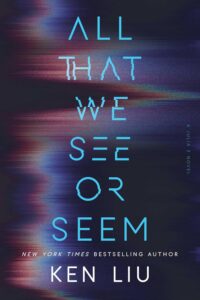
 All That We See Or Seem by Ken Liu
 Series: Julia Z #1
Genres: Adult, Mystery, Science Fiction, Speculative Fiction, AAPI
Published by Saga Press on October 13, 2025
Format: Hardcover, Special Edition
Pages: 419


Source: Owlcrate
Award winning author Ken Liu returns with his first sci-fi thriller in a brand-new series following former “orphan hacker” Julia Z as she is thrust into a high-stakes adventure where she must use her cybersecurity and hacking skills to unravel a virtual reality mystery, rescue a kidnapped dream artist, and confront the blurred lines between technology, identity, and the power of shared dreams.
 Julia Z, a young woman who gained notoriety at fourteen as the “orphan hacker,” is trying to live a life of digital obscurity in a Boston suburb.
 But when a lawyer named Piers—whose famous artist wife, Elli, has been kidnapped by dangerous criminals—barges into her life, Julia decides to put the solitary life she has painstakingly created at risk as she can’t walk away from helping Piers and Elli, nor step away from the challenge of this digital puzzle. Elli is an onierofex, a dream artist, who can weave the dreams of an audience together through a shared virtual landscape, live, in a concert-like experience by tapping into each attendee’s waking dream and providing an emotionally resonant and narrative experience. While attendees’ dreams are anonymous, Julia discovers that Elli was also providing a one-on-one dream experience for the head of an international criminal enterprise, and he’s demanding his dreams in return for Elli.
 Unraveling the real and unreal leads Julia on an adventure that takes her across the country and deep into the shadows of her psyche.
In the near future, there’s a nation driven by technological advances, AI controllers, advanced cyber loopholes, and augmented dream-like sensory experiences. Generative work, entertainment, and crime intersect in an unpredictable web of connections that surrounds a young hacker Julia Z in Ken Liu’s All That We See Or Seem. Part investigative procedural drama and part technological and AI-focused commentary, All That We See Or Seem is an imaginative speculative fiction book filled with insightful discussions around future tech advances and cultural shifts that is held back by pacing issues and lackluster character work, a book whose conceptual brilliance is potentially mismatched with an underwhelming reading experience.
Marketed as a scifi thriller and described by some as having cyberpunk and futuristic elements, All That We See Or Seem is a bit different from other similar sounding books in the genre. Unlike many other hacker or AI-driven books, Ken Liu’s take on the concept is considerably more grounded and realistic. Although set in the future given the technological advances featured, this story is one that could take place in the very near future as many of Liu’s scifi elements are based on hardware and software ideas that are conceptually credible. Instead of the usual fluorescent neon lights, cybernetic enhancements, or full digital world rendering expected based on this kind of premise, the book instead portrays an understated and similar version of America with far more lowkey and plausible tech.
Before getting into the review, it’s important to note that I believe many early negative reviews for this book were based on the book being mismarketed or due to misconceptions on what it’s about. While the technology and AI concepts are inherently scifi given they are fictional takes on scientific concepts, the book feels like it belongs more within the realms of the speculative fiction genre given its inquisitive and speculative discussions around its futuristic elements rather than what most modern readers consider “scifi”. The “thriller” part is also a bit misleading as the story is meticulously paced and slower than most thrillers. Rather, this book reads like a procedural mystery case investigation almost like a BBC miniseries with the way the story is developed. Utilizing a third person omniscient presentation, the story will frequently jump to scenes from the villains’ perspectives much like an on-screen cut. It’s not necessarily a drawback per se but the presentation does lose the air of uncertainty and tension given the reader is in the heads of all the characters and knows their intentions. The technology and scifi elements are also utilized in a straightforward manner, usually for amateur investigation purposes or for on-the-run evasion tactics. This book is relatively low on action, fast-paced thrills, or fully cyber-space elements often attributed to cyberpunk. This is simply not that kind of book and readers should know that going into it.
The main story of All That We See Or Seem is a somewhat straightforward one. A young ex-hacker with a criminal history, Julia is recruited by a nondescript lawyer Piers whose wife Elli has gone missing out of the blue. A minor celebrity in certain circles, Elli is an oneirofex dream artist, a unique entertainment hybrid of a live performer/actor crossed with a hypnotism storyteller. Audience members donning virtual reality headsets enter a suspended state of being awake while dreaming as Elli guides the collective group through personalized experiences through ASMR-like soft-spoken suggestions, conjuring vivid memories or dreams whose value cannot be priced. Piers receives a ransom note and video warning from a mysterious man called The Prince threatening that he will never see Elli again unless he sends The Prince something valuable that she has. What starts with an initially simple request for Julia to verify if the video footage is real or not becomes far more dangerous as the two are forced to run for their lives while investigating who The Prince is and what happened to Elli.
The strongest and most noteworthy highlight of this book is Liu’s thoughtful and very grounded exploration of near-future technological advances and their potential impacts on society. At a quick glance, the idea of a live performer crafting virtual reality dreams may seem a bit out there and more into the fantasy side of science fiction, but the concepts behind it make the idea far more interesting. Life is dominated by AI-based virtual assistants not unlike how they already exist in real-life, but the idea is taken further through the virtual recreation of a person’s personality and nuances through their existing digital footprint and publicly available archival footage. Liu’s ideas for technology such as full digital recreations of rooms based on video footage and photographs, AI-powered search queries or cross-references for unusual patterns of activity, creating deepfake like material and the logistic challenges of identifying what is real or altered, the scifi elements are advances we may very well see come to life soon. The uncanny valley experience of fully simulated recreations of existing people where behaviors or natural tics seem just a little bit off are also included and are a major plot point. But rather than simply introducing these topics as narrative flourishes, Liu writes lengthy speculative discussions around their prospective use, their effectiveness vs risks, and the human factor that carries intrinsic value beyond algorithmic efficiency; Elli’s popularity as a dream artist is largely due to how real and touching her performances are in a society that has lost the flawed yet human touch. While not answering the many compelling questions asked, Liu’s discussions around these technological hot topics are excellent not only for how on-brand and intelligently they are covered, but how well-researched and plausible they are.
In addition to its futuristic scifi discussions, the book also includes a variety of other compelling themes. As the daughter of an Asian immigrant single mother, Julia’s childhood and story touches upon the AAPI experience further explored via her mother’s impassioned protesting and advocacy for the famous American dream in a society and government against them. Liu’s discussion isn’t a single left vs right blasting, but a thoughtful discussion around the effectiveness of loud advocacy that some would write off as being merely performative as well as the negative effects it can draw in the current digital age where every action is monitored and recorded. What seems as an initial side tangent to Elli’s disappearance is later connected to the “why” behind The Prince’s pursuits as well as what took Julia from a timid girl to a skilled and confident hacker.
Noticeably, it’s not an oversight that I haven’t mentioned the book’s plot at all when discussing this book’s brilliance. While the main story’s plot isn’t necessarily terrible, the book’s plot isn’t quite as effective as its speculative discussions. While the story starts off quite strong initially, the book has a recurring trend where it sometimes feels the story gets lost under the heavy theoretical discussions and their technological implications. The book as a whole has a very slow sense of pace but the mystery investigation often feels very stop-go where the discussions are so dense and extensive that the reading experience is heavily impacted. While I usually appreciate a detailed and reflection-heavy narrative, this one felt quite overwritten and tangent-heavy even for me. It also doesn’t help that the book has quite an extensive list of original vocabulary used to rename existing technology, adding unnecessary redundancy and confusion likely to avoid product placements. Apparently this book was initially conceptualized for a shorter novella format extended into a full-length novel, and the extra padding and length is quite noticeable for how sparse the story feels. When the book features Julia doing investigative work or evading surveillance on the run, it’s quite good but there’s simply not enough of it to satisfy most readers outside of non-fiction programming-heavy junkies. At about the two-thirds point, the story abruptly shifts into a second arc that narratively almost feels like a different book while also being rushed and underdeveloped comparatively. I frequently felt like the vision for the story was often murky at best, consisting of a collection of interesting ideas only loosely connected through a vague story that was designed after the fact.
The other prominent issue is that it often feels like the story lacks a sense of urgency for the reader’s attachment to the book’s characters. The most common sentiment I’ve seen for this book is that the ideas included are compelling, but the story and characters are underwhelming to read about. I believe a lot can be attributed to the book’s disappointing character writing. Though Julia is a likeable character and a relatable one for introverted homebodies and computer programmers, it often feels like there isn’t enough time focused on her character in the present, almost all of her development limited to extensive flashbacks that often fragment and disrupt the story’s pacing. Piers on the other hand, fares even worse, being bland and forgettable to a fault. His character is intentionally designed to be the safe and unbothered blank slate as a foil to Elli’s confident and vibrant personality, but it often feels like his character truly has nothing going on to make him memorable or interesting. A lot of the book’s engagement relies on the reader caring about Piers’s plight and conflicted emotions as he discovers new information about Elli, but his characterization, dialogue, and presence doesn’t add much of anything and sucks the energy from Julia’s actions; moments that showcase his legal expertise are few and far between and quite basic. The handling of Piers in general is quite simplistic and ironic given the themes, lacking the human touch. Likewise, the villains’ motives, character writing, and dialogue also leave much to be desired. While I don’t have an issue with the third person omniscient like some other reviewers, I do take issue with how goofy and clumsily their chapters are handled. One is over-the-top and bumbling while the other that’s more interesting is given an underwhelming and off-handed resolution that is quite unsatisfying. Outside of the scifi and speculative discussions, this story is essentially a kidnapping and ransom story that relies on building tension and culprit motivations, unfortunately those being two of the book’s weakest aspects.
As an intellectual and creative exploration around the use and effects of AI and automated processes on society and entertainment, All That We See Or Seem is an outstanding and grounded work of speculative theory. However, as a fictional novel, that’s only half the battle and disappointingly the book’s narrative half leaves something to be desired. Fortunately, despite being the start of a planned series, this book’s story is entirely self-contained like an investigative procedural show episode that concludes the mystery, villain motives, and main character arcs properly where it can be read as a standalone novel. While I’m on the fence about continuing the series personally, this book can be a thought-provoking read, recommended for those interested in digitally simulated theories as long as one goes in with modest thriller or scifi expectations.