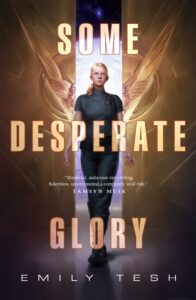
 Some Desperate Glory by Emily Tesh
 Genres: Adult, Dystopian, LGBTQ+, Post-Apocalyptic, Science Fiction, Hard Sci-fi, Space Opera, Time Travel
Published by Tordotcom on April 10, 2023
Format: Hardcover, Special Edition
Pages: 438


Source: Illumicrate
While we live, the enemy shall fear us.
All her life Kyr has trained for the day she can avenge the murder of planet Earth. Raised in the bowels of Gaea Station alongside the last scraps of humanity, she readies herself to face the Wisdom, the all-powerful, reality-shaping weapon that gave the Majoda their victory over humanity.
They are what’s left. They are what must survive. Kyr is one of the best warriors of her generation, the sword of a dead planet. But when Command assigns her brother to certain death and relegates her to the nursery to bear sons until she dies trying, she knows she must take humanity’s revenge into her own hands.
Alongside her brother’s brilliant but seditious friend and a lonely, captive alien, she escapes from everything she’s ever known into a universe far more complicated than she was taught and far more wondrous than she could have imagined.
A thrillingly told queer space opera about the wreckage of war, the family you find, and who you must become when every choice is stripped from you, Some Desperate Glory is award-winning author Emily Tesh’s highly anticipated debut novel.
A Scifi epic about identity, loyalty, and trust across time, space, and alien race, Some Desperate Glory is an ambitious book that covers an impressive amount of narrative material within its sub four‑hundred‑and‑fifty pages. A solid novel on its own, it’s even more impressive being Emily Tesh’s full length debut novel on top of winning a Hugo award and earning a Locus award nomination. At first glance, it appears to be a simple space‑opera story, but it quickly becomes much more, incorporating dystopian concepts, reality‑distorting twists, and excellent queer representation and feminist themes. Yet for how refreshingly modern its story is, this book’s character writing is what leaves a lasting impact. While I was hesitant about the book until the halfway point, I’m thrilled to say it absolutely lives up to its accolades and hype.
Some Desperate Glory is one of those books that is difficult to review without spoilers, as its major twists are integral to the reading experience. Without mentioning its heavier content, the book risks sounding generic and far less interesting than it truly is. The story follows Kyr, the top cadet‑in‑training of her female cohort on Gaea Station, until she receives a shocking assignment that undermines her entire life’s purpose. However, once the book hits the halfway point and pulls out a 180-degree twist on the story, it quickly becomes evident that Tesh had an entire act two hidden up her sleeve that requires the reader to share Kyr’s assumptions to the world and hierarchy in place. Once the story takes off, what starts as a straightforward rebel survivor outpost tale and becomes far more complex and creative.
In most of my reviews, I open with the positives before moving into subjective drawbacks. However, nearly all of this book’s shortcomings occur early on, so reversing the structure makes more sense. The biggest drawback is the presentation of its lore and worldbuilding. Tesh’s worldbuilding is strong and appropriately scaled, but the delivery isn’t very intuitive. Early explanations of Gaea Station’s hierarchy are tricky to remember, the concept of majos and the past wars can be confusing, and the mechanics of Wisdom are convoluted. Early action sequences, particularly when Kyr is on the run or flying through gravity fields, can also be difficult to follow, occasionally feeling like transitional descriptions are missing. While by no means a terrible effort, these early issues are really the only sign that point to this being an author’s debut novel.
The other note that can dissuade readers in the first half is that the book can sometimes be difficult to read for sensitive readers. As stated in the book’s trigger warnings, the book contains sexist, homophobic, transphobic, racist, sexual assault, forced pregnancy, and genocide; there’s more but I won’t cover those. They are fully utilized for thematic purposes and are handled respectfully rather than for shock value, most are only mentioned via discussions, not depicted on page, but the content can still be upsetting for some. The themes and content serve as strong character motivations and internalized sparks for change. Some readers may also find Kyr unlikable at first. Trained in a ruthlessly efficient and resource-strapped environment, she embodies the essence of a hardened soldier with unwavering loyalty, determination, and tunnel-visioning directness even when faced with conflicting situations. The reader is clued in early that the system and society is broken and that her actions are affecting those around her while she is obliviously obtuse or refusing to see what’s happening. This is completely by design and her early emotionally detached chapters form the necessary baseline for her character to grow and develop, who becomes fully admirable and one the reader will desperately hope will succeed by the end of the book (see what I did there).
The book is divided into set parts that correspond to distinct arcs in the story and fortunately once it gets to part 3 at just under the half-way point, everything starts to click. Without spoilers, the story does a complete 180 shift where both narrative’s ambition and Tesh’s writing chops become evident. Up to that point, the story leaves obvious clues and allusions meant to inspire questions. Even with that in mind, the story can and will catch readers off guard and from then repeatedly. Reality is bent and altered, character affiliations and histories are questioned, and the rebel outpost and Prince of Wisdom diplomacy visit are given deeper implications and context. The plot and characters are given a new sense of urgency, becoming utterly gripping to read about and dispelling of the occasional lulls present in the first two parts; the slower pace in part 2 is intentional though to contrast Kyr’s tense life in Gaea Station. I personally thought that the first half of the book was interesting on paper but a tad generic and more “space opera” in theory than in writing, questioning the book’s positive reputation. Then it pulls out the big guns and raise stakes, more than earning the space opera designation with split realities, sentient technology, cult subjugation of women, and thoughtful discussions on xenophobic conflict and cross-culture empathy. The book’s second half made me eat my words and I was thrilled; this is a story that rewards the reader’s patience and then some.
Besides having a well-crafted and compelling plot, the story’s effectiveness can be attributed to Tesh’s outstanding character writing which is where I feel this novel separates itself from the rest of the pack and what likely earned its Hugo award. As previously discussed, Kyr’s character goes from a one-dimensional and aloof soldier to one of compassion, empathy, and unwavering loyalty and the journey she goes on is truly impressive. It’s a slow and meticulous process that Tesh masterfully weaves into the story, character development and plot going hand in hand at every stage of the book. There isn’t an immediate dramatic change, but a carefully written and gradual shift over time. Aspects that are done particularly well is Kyr’s realization that it’s too late to tell or show her loved ones how much she cares, her sense of duty inadvertently pushes others who care for her away, and the immense sense of loss for life experiences, freedom of choice, moments she never knew she was deprived of.
The excellent character writing isn’t just applied to Kyr but also extends to the other characters who are varied in personalities and backgrounds. Much of the story hinges on Kyr’s love and devotion to her brother Mags, and the book cleverly reverses the traditional gender roles of the two characters, their personal strengths, and interests. Kyr’s abrasive and rival squad mate Cleo appears basic initially, but her rocky relationship with Kyr is greatly expanded on after the half-way shift and she becomes surprisingly entertaining to follow. The sassy, individualistic, and scheming mastermind Avi is a breath of fresh air (or a breath of choking death depending on the book’s part) whose spiky personality is both fun and guarded. Every character is given substantial development from their appearances in the first half of the book vs the latter half, and though some are substantially different, the growth to get there feels natural and makes sense. By the end of the book, most readers will find themselves rooting for them to survive, the book giving a very strong found family dynamic and an underdog ragtag team vibe. But the most important role and the outlier in a cast of rough characters is the alien majo Yiso who is initially captured and imprisoned as an enemy invading Gaea Station’s territory. The only character that’s not a soldier, not human, and is poorly understood, their unusual relationship and connection to Kyr is a great representation of the story’s development and trajectory as a whole. A good portion of the character development hinges around how the reader perceives Yiso which is managed strategically. I found the ending to be just about perfect and the quiet, poignant final pages in the dark and silence of space made all the more emotional and satisfying thanks to Yiso’s presence and Kyr’s unorthodox understanding of them.
If the story and character writing wasn’t enough, this book also is heavily queer-centered, major points and elements of the story unable to work without it. Its characters are diverse across the LGBTQ+ rainbow, the most notable being Kyr’s own unrealized interest, her squad mates Vic and Arti who are a sapphic couple and Avi who is a jaded and openly gay young man, plus others who cannot be discussed due to spoilers. The Majos also serve as unique yet effective non-binary representation both at an individual and cultural level. That said, though this is a queer themed book, it doesn’t necessarily follow the subjectively overly positive/sanitized trend of queer joy literature. In a society that has population goal benchmarks to meet, rigid structure, and non-existence autonomy, this story is one of queer survival and finding support in the face of opposition rather than one of positivity and a safe space escapism read, pun intended. Raised in a sheltered and ignorant environment, Kyr visibly struggles with the concept of non-binary vs heteronormative culture, referring to Avi as “the queer” like a caricature of a person, or calling the majo Yiso an “it”. It’s by no means disrespectful to the queer community but serves as an important based character framework to show Kyr’s growth, acceptance, and shift in mindset. This is an area that a lot of queer literature shy away from tackling for fear of upsetting potential readers as well as being a difficult topic and tricky character arc to write. Tesh does a great job with it which as a result, makes Kyr’s character feel even more grounded and real.
Another important aspect worth noting is that although this book is definitively queer coded and tagged, it does NOT have any strong romantic storylines, spice, or flamboyant characterizations. Kindly hear me out before shooting me on the spot for saying this, but despite having good intentions promoting minority voices/authors, sometimes queer books are overhyped and rated gentler than their straight counterparts. That isn’t inherently a bad thing, but it does create a bit of a stereotype that as a result, they can be deemed softer or less intense narratively speaking. There’s also a bit of expectation or stigma that queer SFF books, especially stereotypical Scifi “space smut”, to either have less elaborate world-building, plotting, or for romantic elements to dominate the story. Let it be known that this is not at all the case with Some Desperate Glory which is an elaborate and genuine epic scifi space opera. I’ve read a substantial number of queer books which can sometimes have a distinctive narrative flavor, more casual approach to storytelling, or rose-tinted optimism. TGhis book is the real scifi deal while having great queer portrayal and themes.
Ambitiously crafted with stellar character writing and a fantastic second half, Some Desperate Glory is a wonderful Scifi epic that is authentic in the genre sense while also modern through its queer themes and women‑led narrative. Though its first half can be unassuming and a little convoluted in places, one should definitely stick with it, giving Tesh time to cook and the story to hit its stride. Not only is its story gripping and the intensity consistently built on, but it’s a book whose character journeys are handled even better than the plot with a lot of heart. It being a debut novel means there’s a few spots that could be tidier in the early chapters, but I fully believe this book has the potential to be a lasting new gen scifi classic and a much-needed breath of fresh air in the sometimes stagnant genre.