
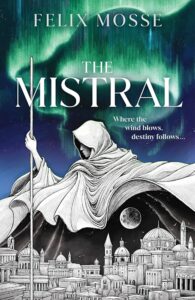
 The Mistral by Felix Mosse
 Series: Spellbinding The Mistral #1
Genres: Adult, British Literature, Fantasy, Dark Fantasy, Epic Fantasy, High Fantasy, Magic
Published by Penguin Michael Joseph on May 27, 2026
Format: Hardcover, Special Edition
Pages: 470


Source: Goldsboro Books
A DYING MAGIC.
A SLAUGHTERED QUEEN.
A WORLD ON THE BRINK OF WAR.The Mistral - a divine, ancient wind - has long swept over the realm, bestowing magical abilities on those destined to shape the future. But The Mistral is dying. As it falters, and fear of all-out war consumes the kingdom, a peace delegation sets out from the land of Terrius to the city of Lurella.
At the delegation’s heart is Swan, daughter of an assassinated queen, who holds a powerful and rare ability. She must seek answers - both to her mother’s murder and her own inability to master her powers. Before it's too late. Meanwhile, in Lurella's duelling pit - The Iron Circuit - Fenne, a feared fighter, comes to the attention of one city ruler, who sees in her an opportunity. As the Peace Pledge begins, Swan and Fenne are thrown together by a dark conspiracy – one that could forever alter not just their fate, but that of The Mistral. And the fragile balance holding the realm together.
The Mistral begins an epic new fantasy trilogy – a sweeping tale of high magic. Of dangerous powers and deadly ambition. And a world on the precipice of the darkest of wars...
Like a callback to classic high-fantasy books but modernized for current readership, the Mistral by Felix Mosse is a wonderfully traditional epic fantasy story. Serving as both Mosse’s debut novel and the start to his Mythic Roots trilogy, the Mistral is expertly crafted, blending a wide variety of fantasy elements held aloft by an ethereal stream of wind and light. Consisting largely of detailed world-building and moving around its large cast of characters like chess pieces on a fantasy RPG board, this book is a refreshing return to the genre’s roots, one that I not only thoroughly enjoyed and found very polished with no notable weaknesses.
As covered in the book’s synopsis, Mosse’s fantasy world revolves around the mystical entity the Mistral, a less turbulent jet stream-like air current crossed with the aesthetics of the aurora borealis or northern lights. Beyond serving as a distinctive visual phenomenon, this aerial force is believed to be root and source of magic, bestowing abilities upon individuals. Not only the source of magic in the land, the Mistral also is a revered religious icon, with two major belief groups interpreting its role and presence differently. Once prominent and beautiful, the Mistral has been slowly dying, its power waning, while nation and socio-political groups are divided on the cause and how to save it.
This book has a wide variety of fantasy elements all connected back to the Mistral and its power. One particularly impressive aspect is how Mosse takes the simple premise of a dying mythical wind and runs with it across the wide fantasy genre. There’s the opening murder of a queen and four-year retaliation that follows while her daughter Swan trains to assume the role. Another nation has developed technological devices to store aether to enhance or grant skills while the academy of scholastic academy believes this development is accelerating the Mistral’s demise; aether/arcanepunk meets dark academia conflict. There’re dueling religions of Constantism vs Zephyrism based on differing beliefs of the wind, an entertainment circuit and dueling league where Fenne fights and works to earn permanent residence, and her friend Thom competes after being expelled from the royal spy circuit for perceived political protest. There’re lengthy discussions of cross-border trade routes, the movement of goods, and the succession of the city’s pit lords that oversee mercantile operations via underground rivers and steep vertical shafts. And then there’s a prophecy involving four powerful roots/individuals that will change the course of the continent of Mycenia. There’s a lot going on and it can sometimes feel like the book is casting too wide a net with its narrative ingredients, but they are all tied back to a secret plot involving the Mistral with each element having a specific role to play.
As the first novel in a planned trilogy, majority of this book covers extensive world-building and lore, taking a lot of time to establish the main nations, political and social groups within each, key figures, and history. The story focuses primarily on the politics and culture of Terrius and Eron, the two nations entrenched in conflict and the home of Swan and Fenne respectively. Following a Terrius diplomatic envoy to Eron to negotiate a peace treaty, this book doesn’t simply follow Swan’s journey to their rival capital, it heavily explores how tensions escalated to this point. Most of this book takes places in Eron, doing a great job illustrating how precarious the situation is and how divided its leaders and factions are. The large ensemble of characters and POV’s explore every angle, affiliation, or school of thought, but centering much of the narrative through Fenne’s eyes is a smart choice. As an outsider from yet another nation with very different culture and responsibilities, she serves as an excellent stand-in for the reader, discovering the nuances of political strategizing. While actual plot movement is limited given the amount of world‑building, the book sets the stage well for what’s to come, ending with a dramatic conclusion that left me eager for more.
Despite the density, the world‑building is consistently interesting and compelling. While political conflict and treachery are expected in an epic fantasy book, I wasn’t expecting how detailed and thorough the book’s mercantile storylines and outsider-residency elements would be. Reestablishing lost trade routes due to ongoing skirmishes, pit leadership succession, the nomination process, and Fenne’s pursuit of permanent residence were all surprisingly engrossing with many pages flying by. Mosse also employs clever writing and storytelling techniques to break up the dense material, one example using various recollections like written text, casual conversation, flashback memories, and training arc sessions as varied history lessons. POV shifts are done effectively based on context rather than one-for-one transitions, and the sense of pace and intensity is consistently maintained. These all may seem like no-brainer writing 101 basics, but many epic fantasies drown the reader with endless blocks of dull exposition that sucks the life out of the dramatic story they’re telling. I’d estimate at least half the book is world‑building, yet I never minded because the material is so strong. The storytelling evokes old‑school RPGs or rich D&D campaigns where lore is as important as plot.
Another highlight is the book’s characters who are quite varied and memorable. Swan and Fenne are suggested to be two of the main characters, being specifically named in the book’s synopsis, but the story features many more. Both are appealing and well-written, Fenne in particularly being fun to follow in the dueling circuit and her quest for residence. Swan isn’t quite as prominent as she shares many of her scenes with the high priest Moraine and the book in general featuring less Terrius-centered chapters vs Eron; after Swan’s first chapter, she isn’t seen again until seven chapters later. However, her story involving the loss of her mother, training to assume her expected role, and expanding her powers of foresight and reliving memories are interesting. My personal favorite is Luck Lamourney, a famed war hero who defended the city during a deadly invasion. Older than most characters and one of the few critical of her own nation, her survivor’s guilt, PTSD, and self‑demotion to running the dueling circuit make her particularly refreshing to read about. Of note, the nation of Terrius is women-led while the two most prominent characters of Swan and Fenne as well Lamourney are all women. There’re also some subtle modernized touches here and there like disabled representation in the form of Eli who also wears women’s clothing, a character with queer flings, themes of immigration and xenophobia, etc. While there are prominent male characters, it’s refreshing to see a traditional epic fantasy written by a male author centered on women with solid development.
While the book is well‑crafted, effectively plotted, and impressively cohesive, it won’t be for everyone. I haven’t read Sanderson or Gwynne yet (though that will change soon, as my Faithful and the Fallen set arrives this month and next), but this book feels aligned with classic high‑fantasy traditions focused on political, cultural, and power‑based struggles. While there are very light interests implied, it’s also devoid of any romance element, at least within this first book. The elaborate world-building is well-suited for traditional SFF readers, but its slower, more measured pacing of the plot and solid though limited action may bore others. I personally loved the mercantile discussions but some may find them initially irrelevant or off-putting. If evaluating solely for the plot, there isn’t much progression until nearly two thirds into the book. Mosse manages the large cast of characters well who each have a part to play, but casual readers may find it mildly difficult to remember who’s who without a glossary for quick reference. Not a negative point, but I also would’ve loved a map of both the Mycenia continent and the city of Lurella for how detailed and varied the locations are portrayed. Perhaps the biggest sticking point is that this book feels like the story has only just begun; it resolves the mystery behind the queen’s murder and the prophecy’s foundation, but readers who dislike lore‑heavy setups may feel like this series entry doesn’t cover much ground.
Thoughtfully crafted, expansive, complex, and authentically epic, The Mistral is a true homage to classic high fantasy. It doesn’t break the mold, nor does it need to; it smartly selects compelling elements and elevates them with its aetherial wind. I originally planned to rate this book in the 4.0-4.5-star range as it peaks a bit too late and lacks narrative highs, but I ultimately decided to bump it higher. It’s a understated and lowkey simmer of a story but one that’s steady, polished and smoothly presented. Its hidden strength is how seamlessly it flows. You don’t realize how good it is until you step back and analyze it critically as Mosse makes the complex storytelling look easy when it’s anything but. Though heavy on world‑building, the material is consistently interesting and lays an excellent foundation for the series to build on. A solid start to the series and a book I’d never guessed was an author’s published debut, the Mistral is a great epic fantasy book for immersive SFF readers and a series I definitely will be continuing as long as Goldsboro and Penguin Michael Joseph sticks with it! (currently a UK-exclusive at the time of this review)
Side note: I loved Felix Mosse’s acknowledgments, where he thanks his favorite author Dan Abnett, known for comics and video‑game tie‑ins. Imagine having two successful writer parents, Kate Mosse in particular being an international bestseller, thanking them for their support but not as writing inspirations. The low‑key and likely unintentional shade had me rolling.