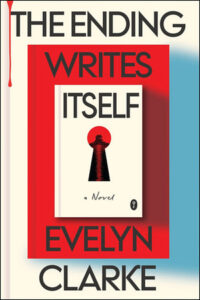
 The Ending Writes Itself by Evelyn Clarke, V.E. Schwab, Cat Clarke
 Genres: Adult, Fiction, Mystery, Mystery Thriller, Thriller
Published by HarperCollins on April 6, 2026
Format: Hardcover, Special Edition
Pages: 343


Source: Mindsight
A PROPULSIVE DEBUT MYSTERY FROM EVELYN CLARKE, THE BRILLIANT AND DIABOLICAL CREATION OF CAT CLARKE AND V.E. SCHWAB
Six authors.
One private island.
Seventy-two hours to write the ending that will change their lives.
Arthur Fletch, one of the world’s bestselling novelists, is a reclusive genius known for his iconic protagonists and fiendish twists. When six struggling authors are invited to spend a weekend on his private Scottish island, they arrive to discover a shocking secret: Arthur Fletch is dead . . . and his last book is unfinished.
Desperate to publish the novel, Fletch’s agent and editor have summoned these writers in the hope that one of them will imagine a worthy ending for this final book. To sweeten the deal, they are offering an irresistible prize: in addition to ghost-writing the last chapter––for a mind-boggling sum––they will also help the lucky writer successfully re-launch their own career, guaranteeing future bestsellers. The catch: the writers have just seventy-two hours to finish Fletch’s magnum opus.
It’s the perfect plot. All it needs is a killer ending.
A ghostwriting challenge with a lucrative reward, a windswept and isolated island estate, and seven authors full of writing insecurities and personal baggage. A book revolving around a potential collab to finish a famed late author’s last serial entry, the Ending Writes Itself is itself a collaborative novel by veteran fantasy author V.E. Schwab and scriptwriter Cat Clarke (yes, pun intended). Pitched as a mystery thriller, this story also doubles as a literary/contemporary fiction book filled with strong commentary and discussions about the publishing industry’s flaws and authors’ struggles. As a study on character writing, this novel gets top marks and is conceptually brilliant. But as a mystery thriller for casual readers, the ending perhaps wrote itself too much with some notable narrative flaws and questionable pacing.
There are quite a lot of books out there about ghostwriting in the publishing industry and ghostwriting job vetting, but has it ever been crossed with a free‑for‑all challenge turned survival story? The Ending Writes Itself is a book that blends familiar mystery‑thriller beats and connects them to the highs and lows of publishing; more often the lows. Easily the most impressive aspect of this book is its strong commentary on the publishing industry’s more problematic aspects and the difficulty of skilled writers who are unable to break out from the midlist. Demonstrated by the various plights and backstories of its seven featured writers, it’s often not a skill gap, but in fact a lot of luck and predetermination by publishers can make or break an author, and this novel does not hold back commenting on that.
A collaboration between Schwab and Clarke who have published books across multiple publishing houses, the struggles of the writers not only feel accurate but also authentic, particularly in some of the characters’ lives where it’s truly do‑or‑die stakes for their future writing careers. The commentary also doesn’t shy away from more cringe and ugly aspects, such as YA authors whose personalities and social media engagement can be more important than their actual writing, the misogyny toward female authors in male‑dominated genres, and the stereotypical dragging of genres like romance or YA, often deemed silly or easy. The discussion around the industry also extends to publishing companies themselves, such as the prevalence of white male leadership, leapfrogging based on personal connections, etc. The book channels the unfairness of it all into its characters’ frustrations and angst, where being an author requires so much more than just a love of writing and storytelling.
Going hand in hand with publishing‑industry discussion are the book’s characters, who are all varied in writing strengths, genres, and personalities. Schwab and Clarke do a respectable job differentiating the different character voices despite the book being written in third‑person present tense, and the character writing as a whole is excellent. Each character’s backstory is interesting and connected to their love of writing or books. This book is also one of peak drama and angst. To be expected from a story involving seven authors desperate to make a name for themselves, there’s a lot of jealousy and insecurity everywhere. This is a particularly good read for those who enjoy messy quarreling or watching sad and petty people putting on a confident face. For many other readers, it’s important to note that the various characters are all initially quite unlikable and heavily flawed by design. As the story progresses and details about the writing challenge are revealed, their negative impressions and misgivings are shown to be purposeful and part of the plot.
As the events on the island progress and the story shifts to one of survival, the book has some pretty clever ideas that put a new twist on familiar tropes and expectations. View Spoiler »
So far, this review has highlighted the book’s strong discussion around the publishing industry, its strong character writing, and its clever ending. I’ve yet to talk about the book’s plot and its mystery‑thriller angle. While this book has a compelling premise, great thematic depth, and is well written and concluded, unfortunately it leaves much to be desired in its presentation and the overall reading experience. As a literary‑fiction or drama novel, this book gets high marks, but as a mystery thriller, I can’t help but feel like it’s not marketed correctly. While interest and tone can be quite subjective, this book’s progression and sense of pace simply feel misguided and incredibly uneven.
While the character writing and drama are objectively well done, the book’s pacing can feel incredibly slow and dry as a mystery thriller due to the first death occurring over halfway into the book. The synopsis talks about the writing challenge, the mystery, the stakes, and a killer at large, but it doesn’t mention the drama at all, which is the vast majority of the book. For those who are solely invested in the core competition and mystery of Arthur Fletcher’s death, final book, and his eerie estate, there’s simply not enough of those elements for what most readers picking up a mystery thriller would expect. While I did not hold it against the book or let it heavily affect my review and score, I felt like the entire first half of the book that was heavily focused on Sienna and Malcolm’s strained writing collab and marriage which was a story I didn’t sign up for (domestic and familial thrillers are one of my least favorite genres and topics). Once the first death finally occurs, the story shifts to new POVs and backstories that feel like they did not have the same amount of time or development as the first two POVs which makes the characters feel shallower and thinly constructed despite having great backstories on paper. It also doesn’t help that while they’re intentionally flawed, the entire cast of characters can feel inherently unlikable and difficult to root for. The story reveals them to be a group of miserable writers with severe self-esteem issues, which you can imagine some will find insufferable to read about.
Additionally, the more overt thriller sections of the book feel too brief, especially the last few deaths and the reveal of the culprit, which felt so rushed that it seemed as if the authors were on a tight deadline or had a hard max page limit to stay under. While it’s great that a lot of time is spent with the first two characters who die compared to most other stories where the early characters are deemed minor and forgettable, here the setup is so off‑balanced in terms of focus and pacing that it feels like something went wrong in the planning/drafting stage. Once those two characters are dead, it almost feels like there’s a void in the story that the other characters can’t quite fill; an effect that’s partially intentional but not to such a degree.
The rushed and questionable execution also disappointingly extends to the culprit and their motives. I don’t know if it’s a good thing that I was able to guess who the villain was almost immediately at the start of the book, but I feel like that’s a problem as the level of suspicion isn’t properly spread across the group of characters. The issue isn’t so much that the reader can guess the villain correctly, but that they can guess their identity despite the book having very little foreshadowing or clues suggesting their actions or motive; it’s a vibe but not particularly well-planned out. Part of that has to do with the choice and approach to their POV shifts and separation (I cannot say more without giving away major spoilers or the order of deaths), but the lack of attention to this character and their background causes the grand reveal to fall quite flat. The motive thematically fits and is functional but in a circumstantial “I guess that fits and makes sense” manner and is almost unintentionally comical with how over‑the‑top it is compared to how grounded the rest of the book feels. While thematically connected and delivering poetic justice, their demise is also quite underwhelming, which is a key element that can make or break a thriller’s impact. This is made worse by the ending and epilogue chapters that have great closing sentiments and are great in theory, but the execution of the conclusion feels lackluster like it’s missing something. Also, considering how eerie the setting is on a cold and weathered Scottish island, the ambiance and immersion are merely serviceable. Whether the book leans into the potential specter of Arthur on the cliffs, the quiet and foreboding isolation, or even a tense competition angle, it could do a lot more. I’m accustomed to Schwab’s immersive and atmospheric style, but whether it is due to the book’s collaborative conception or subject matter, this felt uncharacteristically middling.
As a character‑focused literary‑fiction drama and exploration of the publishing industry’s problems, The Ending Writes Itself is great. Thematically cohesive, thoughtfully discussed, and featuring excellent character writing, this is the type of book that caters to literary critics and peer writers with objectively great details. Yet for how strong its details and clever touches are, for general and casual readership this book feels inherently flawed and feels like it forgot what its original premise and thriller pitch was along the way. If I’m being honest, I personally did not enjoy reading this at all, though I recognized the ambition of what it was trying to do and accomplish. I’m not familiar with Cat Clarke’s previous works and don’t know each author’s contributions to the final novel, but this does have V.E. Schwab’s poignant and sharp character work, which is disappointing considering how conceptually brilliant it is on paper and how much the reading experience is dragged down by a few crucial drawbacks. The potential was so high, and it didn’t work in practice. However, I fully believe this novel can be wonderful and will certainly be an amazing book for certain readers, but for myself and other mystery‑thriller fans, this wasn’t quite what I had in mind. (I received this book via Illumicrate’s Mindsight subscription; bad joke and pun, I know.)