
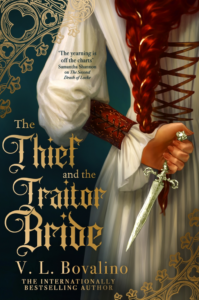
 The Thief and the Traitor Bride by V.L. Bovalino
 Series: The Hand and the Heart #2
Genres: Adult, Fantasy, Epic Fantasy, Fantasy Romance, High Fantasy, Magic, Romantasy
Published by Forever on September 28, 2026
Format: ARC, eBook
Pages: 592


Source: Netgalley
A ruthless spy. A deadly mission. A thief who could ruin it all.
Nore Gordon is a woman of many she can speak a variety of languages, disguise herself in plain sight, and has made a name for herself as a successful wine merchant. But unbeknownst to those closest to her, it is all a front for Nore's true role as the favoured spy of the Lindle crown.
Tasked with infiltrating enemy lands in search of a powerful relic, Nore is forced to engage the services of a great thief. Unfortunately, the only person for the job is her estranged husband Caspian. Both Nore and Caspian bear the scars of the disastrous end of their marriage, but if they are to survive their deadly new assignment, they must pose as a happily married couple to avoid detection.
As danger closes in, Nore finds herself tangled in a web of lies and deceit-and though Caspian is at the centre of it all, she may not hate him as much as she once did. But Caspian has betrayed her before, and trust can be far more deadly than deception.
The following review is based on a complimentary ARC provided by Forever, an imprint of Grand Central Publishing.
Marketed as a new standalone story, V.L. Bovalino’s The Thief and the Traitor Bride is a fascinating book conceptually that has multiple identities just like Nore and Caspian. Featuring new main characters, a different romance trope, new magical system rules, and more, this book is a brand‑new story in a familiar world that is expanding in scale and complexity. Despite its new tale and characters with different careers in the high fantasy setting, this book is very much spinoff sequel to The Second Death of Locke, or at least a narrative epilogue after the previous book’s open‑ended conclusion. Expertly crafted, beautifully written, and featuring perhaps even better character development compared to the previous entry, The Thief and the Traitor Bride is an ambitious slow‑burn fantasy romance epic.
Before getting into the review of the book itself, I know quite a few people are desperate to know if this book gives any closure to Grey and Kier, as the first book ends on a dramatic and rather open‑ended note. I can happily report that The Thief and the Traitor Bride definitely follows up on how they’re doing, surprisingly far more than you would expect given the book’s synopsis. That important PSA aside, and also related to this review’s opening point, The Thief and the Traitor Bride is a very ambitious book that takes on a lot of different topics and goals as an important entry in the series while also needing to tell a satisfying story that can stand on its own. I previously enjoyed The Second Death of Locke but had reviewed that the ending felt rushed, and its open‑ended, somber last note wouldn’t be every reader’s cup of tea. I also enjoyed the romance but found it repetitive at times or constraining the scope of the story, the book uncertain whether to commit to the high epic fantasy it was hinting toward or sticking to safer, more comfortable romantasy beats.
Right off the bat, this book makes a clear choice, feeling considerably more high‑fantasy‑heavy and upping the level of detail considerably. Unlike the first book that took place entirely in Idistra, mostly within two nations plus the Island of Locke, this one spans multiple continents, and the politics are far more expansive. From an Instagram post before the first book was even published, Bovalino shared that the map with a ship in the corner was imagined having characters from the second book on board, as well as a medallion detail and references to the mainland continent where Sela studied abroad in Lindell. This second book takes the reader to a Lindell port of call where estranged and separated spouses Nore and Caspian have ties that sit quite literally off the map. Bovalino has done extensive worldbuilding in this book, with each nation having distinct magic systems, cultures, and political structures.
While Grey and Kier’s story was largely on the ground, through trenches and battlefields, Nore and Caspian’s spans multiple continents and nations and involves a substantial amount of history and politics, very much traditional epic fantasy worldbuilding. The politics and figures pulling the strings behind Nore and Caspian’s missions in Idistra, their rough upbringings and conflict, and the future of Idistra’s magic attributed to the recently resurrected Island of Locke are very solid, full of unexpected twists, and definitely make this book worth picking up even for non‑romantasy readers. The scale of the series and interconnected nature of every loose thread from the first book is expanded and refined here.
For fantasy romance and romantasy readers, there’s also a lot to like. While Grey and Kier’s romance largely followed the childhood‑friends‑to‑lovers trope, Bovalino completely switches things up with Nore and Caspian. While on paper their relationship seems like a standard second‑chance romance and betrayed/jaded enemies‑to‑lovers arc, Bovalino’s strong plotting and character writing elevate the material substantially. Whether they’re enemies, allies, captor x prisoner, or something in between, the two have great chemistry, with this book having even more conflicted pining than the first one.
Most of that can be attributed to the excellent character development of both main characters, Nore in particular. Initially an individualistic and ambivalent lone wolf who’s all business for her own survival, her character growth, caring about others, the nations, and simply doing the right thing, is beautifully handled. As older characters than the romantasy norm, the story follows their relationship as teens through adulthood, both together and apart, which provides rich narrative material to work with. Their estranged separation, unexpected reunion, and unorthodox work partnership with conflicted feelings are done wonderfully.
Both Nore and Caspian have ties to Lindell, but unlike the first book’s protagonist, they are far more removed from their residence, particularly Caspian. Nore being a spy and Caspian a thief leads to different types of action and development from the first book’s more standard knight‑and‑mage combat; this one involves far more mystery and investigative work vs. battles, which is a unique narrative flavor. For those who found the first book heavy with national honor, responsibilities, and rigid structure, this book goes in a completely different direction, which helps it stand out. Of note, this book continues the first book’s strength of having great diversity, particularly with queer representation which is a consistent highlight in Bovalino’s work.
I touched on this briefly already, but another aspect this book gets right is balancing its own story within the context of the series as well as building off the first book’s ending. While Nore and Caspian are brand‑new characters whose stories and lives are self‑contained to this book, the background behind their personal missions and the timeline of events overlap and connect with The Second Death of Locke. Taking place several years after the end of the first book, many of this one’s mysteries involving the unstable magic in Idistra and the “Tyrant Queen” are huge narrative hooks, and while the story isn’t necessarily poor early on, it truly finds its momentum once Nore and Caspian sail to Idistra and the Isle of Locke.
After Grey’s ascent as Queen and the return of the destroyed island, this book answers the question of what comes next, how the other nations have reacted to its return, and the overall fragility of the magic system and sense of peace. This book balances its own story with rounding out the loose ends of the first book well, and those who have read the first book will be rewarded with insightful and interesting second perspectives from a character ignorant of Grey and Kier’s previous adventures.
While this book can technically be read on its own or perhaps out of order, I think the marketing of this book as a standalone story is a mistake given how many details would be missed if read blindly, not to mention the context of the majority of the back half of the book. While Bovalino takes time to reintroduce concepts that readers new to the series may be unfamiliar with such as the well and mage magic system, the history of the Locke being destroyed, and the power vacuum and scrambled succession that followed, it’s simply not enough to bring them up to speed. This story is also dense and very complex, one that can easily confuse casual or romantasy readers unaccustomed to political‑heavy high fantasy narratives. Without reading the first book, this book will be exponentially more confusing and difficult to follow. I had read the ARC for the first book over a year ago; on multiple occasions I found myself wishing I had skimmed through or reread parts of the first book as I felt I was missing details, references, and not being able to reflect on how returning characters have aged or changed over time, particularly the soldiers in the first book now adjusted to political and domestic life on Locke. Some of this book’s best moments involve quiet scenes with the Queen, which can’t be appreciated without experiencing Grey’s previous struggles and devotion to her people.
While the worldbuilding, character writing, and plotting in this book are very strong, improving on some of the weaker areas of the first book, its ambitious goals are perhaps the book’s biggest consideration and potential drawback for prospective readers. Compared to the first book, this one is considerably more political and heavier on international relations and information trading per Nore’s skillset. I consider this to be a highlight, as I felt the first book underutilized its own world and high fantasy elements, but it gives the book a noticeably more careful and methodical feel. As complex, twisty, and unexpected as this book’s plot can be, it’s very dense, which can it less appealing and accessible for casual readers.
Compared to the first book’s five‑hundred‑page count, this one comes in at well over six hundred pages, and at times you can really feel its length. Involving spy work and thievery, this book has fewer traditional action scenes and is more mystery‑based, which is a nice change of pace but can feel quite different from the first book most notably in its sense of pace and scale. The detailed history and worldbuilding are great for epic and high fantasy readers but may be less well‑received by readers preferring more romance.
This book accomplishes a lot with its story, and objectively it’s very well done and polished, yet the story can still feel a bit slow. While the content itself is generally interesting or included for worldbuilding purposes, much of the book’s second part felt like tangential filler, failing to keep up with the book’s strong start and romantic‑angst‑filled voyage to Idistra. The book’s romantasy‑flavored content feels the weakest and most typical in this section, on top of Nore and Caspian’s investigations lacking compelling developments.
Additionally, I personally found the new characters Gail and Terlo to be somewhat forgettable and less interesting compared to Nore and Caspian or the side characters in the first book, their introductions and main appearances coinciding with the slowest and driest part of the story. I would’ve preferred it if this section was abbreviated, with more time spent on Locke instead as it has stronger hooks especially for returning readers. For those only interested in the fantasy romance, I can also see many being frustrated with how slow the romance progresses, despite it always being in the background and being a major contributing character motivation throughout the book. Nore and Caspian’s relationship dynamics and growth are excellent, and the ending feels fully earned after the long and rocky journey they go on, but this is obviously a poor fit for those who prefer spice‑heavy and “fun” romance‑forward romantasy books; the thirsty gazes, pining, and Caspian’s temptations are chef’s kiss, though.
Ambitious in its conception and juggling its new characters’ stories while building off the previous entry’s ending, this book is largely a success. Regardless of story is doing, Bovalino’s writing is consistently excellent, pairing great plotting with her elegant and dramatic prose considerably more refined than the vast majority of romantasy books out there. Better yet, this book is much more of a direct sequel to the first book than advertised and one that many readers are desperate for, presented in a unique and refreshing way via new character perspectives. For those who might’ve been disappointed or turned off by The Second Death of Locke’s condensed or open‑ended conclusion, rest assured that this one ends on a more decisive note that’s not only more satisfying but also more cohesive and complete, with all major plot threads accounted for. Though the book’s grand scale and length can be trickier to follow and keep up with compared to most of its more casual and straightforward fantasy romance peers, The Thief and the Traitor Bride is a very well‑written book worth picking up for returning fans and new readers alike, just make sure to read the first book first.