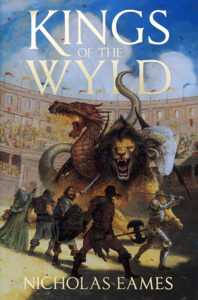
 Kings of the Wyld by Nicholas Eames
 Series: The Band #1
Genres: Adult, Adventure, Fantasy, Dark Fantasy, Epic Fantasy, High Fantasy
Published by Orbit on February 20, 2017
Format: Hardcover, Special Edition
Pages: 498


Source: The Broken Binding
Clay Cooper and his band were once the best of the best -- the meanest, dirtiest, most feared crew of mercenaries this side of the Heartwyld.
Their glory days long past, the mercs have grown apart and grown old, fat, drunk - or a combination of the three. Then an ex-bandmate turns up at Clay's door with a plea for help. His daughter Rose is trapped in a city besieged by an enemy one hundred thousand strong and hungry for blood. Rescuing Rose is the kind of mission that only the very brave or the very stupid would sign up for.
It's time to get the band back together for one last tour across the Wyld.
Mid-life aging, mercenary glory, and good old-fashioned cross-country adventures have never been as fun and easy to enjoy as Nicholas Eames’s Kings of the Wyld. DnD-style fantasy at its finest, this book nicely balances fast-paced action and humor with unexpectedly strong themes of family and brotherhood. Chaotic and intentionally silly when it wants to be, framed by serviceable worldbuilding and epic fantasy elements, this book is incredibly entertaining provided one isn’t opposed to fantasy “bro” style humor and tone.
As far as book synopses go, Kings of the Wyld’s summary is spot on, what you see is what you get. Described as a story about the once mean, dirty, feared, and famous group/band, the members of Saga have since gone their separate ways, aged and dulled by time. The book’s story is roughly divided into two main narratives: the first consisting of Clay and his ex-bandmate Gabriel tracking down the other Saga members to convince them to join what appears to be a suicide mission to save Gabe’s daughter Rose, and their journey across the dangerous stretch of the continent called the Heartwyld to reach her. The overall story is relatively simple despite being set within a high fantasy world and having prominent epic fantasy elements behind the political turmoil of nearby nations, as well as the hordes of once-individualistic beings besieging the city of Castia.
While the premise and overall narrative may feel familiar to some, what sets Nicholas Eames’s duology (or trilogy, if Outlaw Empire is ever finished) apart is its comedic and sometimes mildly chaotic tone. Taken at face value, the story on paper is a grim one: a desperate father convinces his friend and company to venture across a dangerous forest infected with a plague, followed by a foreboding and icy mountain range, only to face a monstrous army of hundreds and thousands with just five long-retired mercs. Yet the book does its best to put an upbeat spin on that story at every opportunity. Narrated by Clay Cooper, the calm and steady member of the band, this book is filled to the brim with funny jokes, hijinks, and laughs that consistently land. While the stakes can be high and the story graphic at times, the book doesn’t take itself too seriously and is simply a really fun time. Paired with excellent action, a nice mix of hack-and-slash with magic, and a strong sense of adventure that evokes a DnD campaign feel, this book is refreshing and a great read for those burned out on too many serious epics or melodramatic romantasy books. That said, there are darker elements that prove there’s substance to the story, such as the deadly rotting plague that has no cure, the enslavement of magical beings whose intended slayings serve as live entertainment, and Saga members’ individual personal conflicts. Eames’s prose is also very accessible, balancing crude jokes with dark humor, consistent wit, and a good dose of wistfulness during quieter moments. This book has a sense of confidence and flair, rarely betraying its author debut novel status.
In addition to having a well-pitched tone, another one of the book’s highlights is its cast of characters, all entertaining and easy to root for. All five members of Saga are varied in terms of personality and backgrounds, and even though the book doesn’t show their previous adventures and conquests in detail, the story does a great job conveying not only their past fame but also their tight bonds and brotherhood; Clay and Gabriel’s platonic bromance in particular is very well done. The book’s appealing characters aren’t limited to just the Saga members themselves but also include recurring figures such as their past handler/job booker Kallorek (and by good, I mean a living piece of garbage that’s well-written), Lady Jain and the Silver Arrows (some of my favorite banter-filled scenes), Matrick’s wife Queen Lilith, and the villains. While Kings of the Wyld is very much a fantasy bro, one-for-the-bois kind of book, it also has some tastefully modernized aspects such as including both physically and politically powerful female characters who consistently best Saga’s men, using metaphors to touch on xenophobic stigmatism, and having queer representation. Moog is not only a consistent scene-stealer with his unhinged magical items, but his character arc involving his late husband Fredrick is one of the book’s more emotional storylines.
While this book has a lot going for it and is easy to enjoy, it isn’t perfect and has a few minor weaknesses. As a character story with action and adventure, the book is a resounding success. However, it’s clear that Eames has greater ambition for the book, shown by multiple prominent political nations and leaders with various cultures and agendas, as well as the general movement of forces against the hordes of monsters. While the book’s worldbuilding is appropriately detailed for the story it’s trying to tell, it’s largely serviceable at best and scattered and unfocused at worst. Upon a closer look beneath the humor and fun, the epic fantasy aspects aren’t particularly strong, and the book has a habit of presenting heavy chunks of lore and politics in dense chapters that feel dropped into place. This is most notable when Clay and Gabriel are tracking down Ganelon and subsequently meet various leaders of different nations. So many leaders, nations, and affiliations are introduced back-to-back, which not only can be confusing but has relatively little to do with the plot, at least within this book specifically. It may be a case of Eames setting pieces in play for the sequel given the book has a “the end… for now” feel to it, but it feels less effective and precise; the story is far more confident and successful on a micro level than on a larger macro scale. This also becomes more evident when it comes to the villains’ motives, strategizing, backgrounds which are fine but nowhere near as good as the Saga member’s development.
Another qualm I had with the story is that after Saga is assembled and the band is making its way across the Heartwyld, the story starts to veer in random directions with perhaps unnecessary bloat. Compared to the first half of the book, the second half can feel like a collection of random events occurring into the forest, and while interesting to read about individually, don’t add much narrative depth for how long they are. Additional side characters are also added who feel unnecessary and disrupt the group dynamic of Saga. And while the content is more serious and darker to reflect the danger of the area, these events don’t feel quite as exciting or grand as earlier ones.
The book is also meant to have a rock band/music theme, given each chapter has a soundtrack listed at the end of the book and mercenary groups are called “bands,” with references like Matrick’s nickname “Matty Skulldrummer.” If I hadn’t read the author’s acknowledgements or seen comments from readers who felt The Broken Binding’s edition loses the rock aesthetic, I would’ve never noticed the connection, and I know I’m not the only reader who feels that way. If the book’s pitch was meant to have a clear rock music band theme, I don’t think it’s executed clearly enough. I actually felt like the Saga members resembled a washed-up boyband group doing a ten-year reunion tour after disbanding, which is likely not a positive takeaway considering Eames’s musical taste and influences. And while the book’s tone is its greatest selling point, it can also be a drawback for readers who may be put off by its slightly crass humor or its testosterone-fueled masculine lean. The synopsis and marketing make it clear what readers are in for, but this is obviously going to be a poor pick for many fantasy readers accustomed to fantasy/romantasy books penned by popular female authors; you can tell this is a dude’s book.
Featuring grand adventure, good action, great characters, and of course a ton of laughs, Kings of the Wyld has a little bit of everything wrapped up within an accessible package. Eames’s humor consistently hits all the right notes while having substance behind it. While I have some nitpicks with Kings of the Wyld, at the end of the day I don’t know how much they really matter considering how entertaining it is. The story is just a lot of fun, though I personally enjoyed reading it over the course of a week rather than marathoning it; I can see the potential for it to tire the reader, particularly in its less focused back half. That said, this is a great book worth reading for those looking for something refreshingly cheeky, on top of it being a very confident author’s debut. Even if I hadn’t already received a copy of the sequel Bloody Rose via a book subscription, I would definitely continue this series (though I’ll pick it up after a few other books in between, so the humor won’t start to drag when reading them back to back). This is a fun read for most traditional fantasy readers but should be a must-read book for fantasy guys in their late thirties and older (or also an amusing experience for their partners/spouses that are exasperated with their shenanigans).
Note: While a third book was announced to be in the works, as of eight years later there’s still no updates from Eames or signs of it being close to publication which effectively makes this series a duology. Even if Outlaw Nation never comes out, Bloody Rose ends with a decisive concluding note that fully works should it end up also having to function as the series conclusion. Do not hesitate giving this series a try even though some platforms list this series as ongoing or incomplete.