
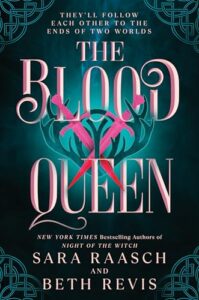
 The Blood Queen by Sara Raasch, Beth Revis
 Series: Spy and Guardian #2
Genres: Adventure, Fantasy, Fae, Historical Fantasy, Low Fantasy, Magic, Romantasy, Folklore, Historical Fiction, Scottish Literature, Young Adult
Published by Sourcebooks Fire on October 6, 2026
Format: ARC, eBook
Pages: 304


Source: Netgalley
In this stunning sequel to The Crimson Throne, Alyth and Samson must infiltrate the fae court to prepare to face the bloodthirsty army of the High Blade who is intent on destroying both the mortal and fae worlds. From the New York Times bestselling authors of the Witch and Hunter duology, Sara Raasch and Beth Revis, comes the conclusion to this incredible romantasy duology. Alyth and Samson finally know the identity of the High Blade, leader of the bloodthirsty Red Cap army, and it's someone they never suspected. They'll use every bit of courage, smarts, and luck they have to escape her grasp and flee to the fae court, where they hope to find aid in the fight against the Red Caps. But the fae princes have been apathetic since the Faerie Queen disappeared years ago at the hands of the High Blade. They seem unwilling to help. And if they find out Samson's true identity, he'll be killed and Alyth banished. Alyth and Samson can only depend on each other and their love as they navigate fae politics, try to win allies, search for the missing queen, and face down the greatest threat the two worlds have ever known.
The following review is based on a complimentary ARC provided by Sourcebooks Fire.
The second half of Beth Revis and Sara Raasch’s Scottish-inspired historical romantasy duology, The Blood Queen is an intense assault of a YA fantasy novel. Picking up the story right where The Crimson Throne’s cliffhanger ending leaves off, this book is a fast-paced fantasy read packed with action, lore, and bringing the conflict of the invading red caps to a dramatic conclusion. Featuring likeable characters, snappy pacing, and strong Scottish folklore, The Blood Queen is a solid YA read only mildly hindered by uneven content between POV’s, pacing that can feel rushed, and a notable lack of historical fiction elements compared to its predecessor.
After the dramatic cliffhanger ending of The Crimson Throne, this book resumes the story and rounds out the battle between the red cap forces and the Alyth’s fae connections with both the human and fae worlds at stake. The first book featured a wide array of narrative elements that covered fae and human portal-based worldbuilding, Scottish folklore, and historical fiction elements featuring real historical figures. Given that the villain is only just revealed at The Crimson Throne’s conclusion, this book has a lot of material to cover while wrapping up the story.
In my previous review for the ARC of the first book, I found the pacing to be quite quick. This book cranks the speed and intensity up even further and can feel like a blitz assault of action and plot. Those that may have found the first book to be a bit dry will more than certainly find this one to be more entertaining, with most of the book spent with Alyth and Samson either on the run, crossing huge distances in both the human and fae worlds. Besides the necessary and expected fae lore and politics, the story also continues the series’ notable influence of Scottish folklore that adds great flavor to the fantasy adventure. All of the Scottish creatures and beings previously introduced play a notable role in this book’s story, particularly in the back half where the different storylines and narrative elements begin to connect. Real locations are given light fantasy dressings or history, the Gulf of Corryvreckan being a particularly unexpected yet personal favorite. Despite featuring quite a few battles, confrontations, and folklore, this book is crafted to meet the conventional YA novel format and actually comes out over sixty pages shorter than the first book, meaning the pacing is quite snappy, even quicker than the first book’s which already felt fairly fast-paced.
Continuing the series’ dual POV presentation, this book handles the perspective switches better than the first book, aided by the story largely keeping Alyth and Samson together (I previously reviewed that I found their chemistry and stories less interesting when they were separated, particularly Samson’s). Where the parts of the first book could feel repetitive due to Alyth having to repeat previously introduced or covered information to the reader again for Samson’s knowledge, this book avoids that problem entirely, largely using Alyth’s POV to cover the core narrative and plot developments while using Samson’s as an outside, from-the-sidelines view, particularly during the fae court arc. Additionally, with the cat out of the bag, Samson’s POV has added interest and insight to his powers, which gives his perspective more material to work with, improving on another point I previously critiqued where his chapters felt notably less interesting than Alyth’s.
Like the first book, Alyth continues to be a wonderful protagonist who is easy to root for. A great mix of resilience and resourcefulness wrapped up in a scrappy demeanor, she avoids the common edgy character pitfall of coming off as overly angsty or insufferably overconfident. Though Samson’s character loses some of the smooth, charismatic air that is used as a mask and tool of the trade, he has more going on following the twist developed at the end of the first book which gives his character more depth and conflicted emotions. While some other readers negatively reviewed their romance as being insta-love or moving too fast, being this far along allows this book to use their devotion to each other to up the tension and ante. The story utilizes the fated lovers and sacrificing oneself for the other tropes quite effectively while also avoiding the surface-level and typical romantasy content or longing and thirsty gazes that can cheapen the feel of the book. Combined with a dense plot, this book feels better classified as a YA fantasy romance novel versus the first book, which had a more overt romantasy flair and lingo that could feel out of place.
While this book’s intense plot and better handling of its two POV’s and character developments can make this story feel more engaging, there are a few other areas that can feel like a step down compared to its predecessor. Most notably is the nearly complete absence of the historical-fiction elements that gave the first book great context and narrative creativity. Aside from featuring the two Queens and William Cecil, who were previously introduced, this book doesn’t have any prominent historical connections or references, which is disappointing. Considering how infamous and colorful the history between Queen Elizabeth I and Mary were towards the end of their conflict, it was a bit of a letdown how this book from the get-go completely separates this book from history via an in-universe explanation. It functionally works for the novel but feels like it drops a key aspect that made the first book more distinctive to me in the sea of fae-based romantasy books. The Blood Queen partially redeems itself with its ending which has a clever mechanic to reframe its place in loosely inspired history, but the creative choice to isolate this book’s story wasn’t to my personal taste.
Additionally, while Samson’s POV and character is largely improved in this book, his perspective still feels like it’s lacking in content and playing a supporting role to Alyth’s. His devotion to Alyth feels like an overused crutch for his chapters to lean on, where his love of her becomes most of his personality, mostly losing the spy and guardian dynamic the series is based on and using very little of his skillset outside of the first few chapters. His added powers and their ramifications add more substance, but Alyth’s chapters still feel more interesting and have notably better development. The difference is so noticeable that her chapters can be read like a solid fantasy romance story, while his read akin to a more generic romantasy one instead.
Another casualty of the book’s ambition and pacing is some of the ambiance and worldbuilding details present in the first book. The strong sense of fantasy adventure and otherworld awe while in the fae realm is present at times, but is far less prominent due to how fast the story has to move to fit everything within only three hundred pages. The backstory of the red caps, the invading forces, nuances of fate, and the missing fae queen are all great ideas and concepts, but they consistently felt rushed and underdeveloped due to the speed of the story. Particularly for the Scottish folklore elements and those involving the fae queen’s association with spiders, it sometimes felt like the fantasy mechanics were being introduced on the fly compared to how purposeful and well-placed the previous book’s details and court politics were. The book is appropriately pitched for YA readership or those that have shorter attention spans that want an exciting story, but for more detailed readers that value immersion and depth in the story, this one can feel a bit lacking. Full of action, fantasy folklore, and devoted romance, The Blood Queen is an exciting and largely successful conclusion to Revis and Raasch’s second collaborative series, ending Alyth and Samson’s stories on a high note. Leaning heavier into the fae aspect and red cap fantasy content, this book is engaging and intense, though noticeably lacking the first book’s prominent historical-fiction references. While its fast-pacing results in less atmosphere and rushed lore that doesn’t have the level of detail or time invested for its ideas to reach their full potential, it’s a well-pitched YA novel that will likely satisfy younger and casual readers looking for an action-forward romantasy series with respectable Scottish folklore.