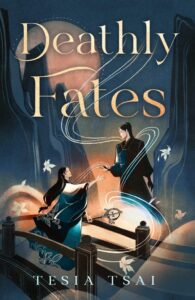
 Deathly Fates by Tesia Tsai
 Genres: Adventure, AAPI, Fantasy, Fantasy Romance, Magic, Romantasy, Young Adult
Published by Wednesday Books on April 14, 2026
Format: ARC, eBook
Pages: 368


Source: Netgalley
A sweeping debut inspired by the Chinese folk practice of necromancy, Deathly Fates is perfect for fans of Descendant of the Crane, The Bone Shard Daughter, and A Magic Steeped in Poison.
As a priestess paid to guide the deceased home, Kang Siying has never feared death. But when her beloved father collapses, Siying realizes that even she is not free from the cruel grasp of mortality. Desperate to provide her father with the medical aid he needs, Siying accepts a dangerous job that promises a generous commission, and travels to a hostile state to retrieve the corpse of a missing prince.
But the moment Siying places her reanimation talisman on the dead prince's head, rather than make the corpse obedient to Siying's commands, the talisman brings the prince back to life. Worse, he won't stay alive for long—not unless he absorbs enough qi, or life force, to keep his soul anchored to his body.
In return for a reward worth twice her original commission, Siying agrees to aid the frustratingly handsome prince in finding and purifying evil spirits for their qi. But as they journey across the countryside, encountering vengeful ghosts and enemy spies alike, they gradually uncover dark secrets about the prince's death—secrets that could endanger both Siying's father and their entire kingdom.
This review is based on a complimentary Advanced Reader Copy provided by Wednesday Books, an imprint of St. Martin’s Press.
A necromancer priestess in foreign territory, a mysterious corpse that isn’t as dead as they should be, and the quest for qi energy across a tense Kingdom under authoritarian control, Deathly Fates has a lot of strong narrative elements in a story inspired by Chinese Taoist mythology. Featuring strong themes such as familial responsibilities, grief/loss, and the corruption of power, Tesia Tsai’s debut novel is a fast-paced and accessible YA fantasy story that has a good mix of adventure, action, age-appropriate spooks and mild horrors involving the dead carried by a very compelling premise. Well-plotted and generally appealing, I personally found this book to be an underwhelming and juvenile in its execution, but is a book with lots of good ideas that is well-suited for young pre-teen readers.
The story follows Kang Siying, a young but skilled ganshi priestess who uses talismans to reanimate the dead to return their corpses to their loved ones or to release their spirits from this world. Given the book’s likely intended YA and younger readership, the book follows its summarized blurb and throws the reader and Siying right on to a death-ridden battlefield where she immediately resurrects her assigned corpse within the first ten pages. While YA and children’s books generally have faster pacing suited for younger reader short attention spans, Deathly Fates has a very fast breakneck sense of pacing that has a snappy, no nonsense feel to it. Rather than opening the book with lengthy world-building and a detailed introduction to the Sian and Weng state political conflict is an overarching part of the story, the book does a serviceable job at unveiling details on the fly as Siying and prince Renshu travel through the countryside, encountering various spiritual forces haunting the land.
Outside of the fascinating premise of a death priestess who reanimates a sentient and possibly living corpse, another one of Deathly Fates’s highlights is its great paranormal fantasy action sequences. Despite being a priestess primarily dealing with dead corpses, Siying and the story have a strong mix of magical combat, magical talisman use, and supernatural visions. As Siying and Ranshu make their journey back to Sian and look for evil spirits to purify to obtain their qi crucial to sustaining Ranshu’s semi-alive condition, they encounter a variety of spirits with different powers, threats, and connections to the Sian/Weng conflict. Particularly with the second spirit that is found in a decrepit haunted mansion, the book features good action, otherworldly delusions, and memories that are quick and varied. Despite Siying being a priestess and Ranshu being a trained soldier, the book refreshingly reverses the traditional roles with Siying doing most of the fighting and in his weakened state, Ranshu being the supportive and weaker partner of the duo.
While the fast pacing prevents the story from ever feeling lethargic or overwritten, I personally found it to be a major detriment and issue that heavily affected my enjoyment of both the story and my overall impression of the book. While the story forgoes a typical lengthy introduction and overview of Deathly Fates’s lore, I constantly felt like it desperately needed more world-building and information to give the reader context to the political conflict that connects all of the story’s major events and storylines. Strained relations between Sian and Weng supposedly make Siying’s priestess tasks and responsibilities in “enemy” territory tricky, but there’s no reasoning or indication on why that is so until over halfway into the story. The King is repeatedly referred to as corrupt, abusing his power, and depriving the common people of resources but the reader is simply told these facts far too late into the story repeatedly rather than it being demonstrated or shown organically. From start to end of the book, I didn’t feel like I had any sort of idea of the time or place of Sian, anything about it apart from the Weng state’s desire for change, and that there’s some sort of tax or unfair accumulation of resources. YA books don’t necessarily have to have the most ambitiously crafted plots of twisty storylines, but this book’s story felt overly simple, predictable, and at times even derivative for the genre.
The fast and abrupt feeling is also a common problem with the book’s storytelling and general lack of development across the board. Besides physically and temporally jumping between towns wherever an evil spirit is located, key storylines such as Siying’s grandfather Baba’s poor health and need for expensive medicine is introduced early and forgotten until the conclusion, her distant relationship with her sister comes out of nowhere in the last quarter of the book, and the character development feels like it swings in a wild 180 shift at the end with little development to get there. This is most notable in Siying who is introduced as goal and job-oriented, official, honoring the dead who then drops all her values in the action-packed but forced final conflict. While the Ranshu’s character development is more appropriate as the plot provides more time and examples demonstrating the flaws in his father’s control of the kingdom, everything feels like it’s being run on fast-forward speed. The book is also described as a fantasy romance but again, but there’s so little time spent on character development making their romance feel like an afterthought. What little G-rated romance that’s included felt like an instant jump from strangers to lovers fits which was disappointing.
While most of the aforementioned flaws could be overlooked thanks to the snappy action, what was more disappointing for me personally was the lackluster prose and weak dialogue. While I don’t expect YA books to have the most flowery or poetic writing styles nor have the most nuanced conversations, I was very underwhelmed by Tsai’s presentation of the material; the dialogue between Siying, her parents, and sister in particular felt awkwardly phrased and unnatural The storytelling and dialogue all-around felt so basic and juvenile that I had to double-check what the intended age range of readers this book was for, feeling more like a kids adventure outing vs a sweeping fantasy epic described. The story has a fair bit of violence and some injury/dead body visual horrors that are a bit too much for a children’s book, but shallow level of detail, basic characterizations, and wooden writing felt akin to a middle school level book for 10–13-year-olds. If that was the intention for this book, by all means some of my critique and review may be reaching too far. However, this book’s marketing and store platform listing say the age range is for 13-18 which feels way off base; classifying Deathly Fates as a YA book is quite pushing it.
Featuring a compelling premise on paper and great narrative elements, by all accounts Deathly Fates should be a standout YA Asian-inspired fantasy adventure mixing paranormal combat, political conflict, unexpected romance, and conflicted familial responsibilities. Unfortunately, the execution and development across the board felt lacking to me which resulted in a lackluster and bland reading experience. Also of note, the book’s synopsis vs the actual content feels a bit mismatched where the characters spend most of the book purifying random spirits rather than the advertised discovery of the prince’s mysterious death and political conflict in the kingdom (the developments just kind of fall into their lap instead). I struggled and personally did not enjoy this book at all, but I can see this being a good recommendation for pre-teens looking for a story tackling heavier topics like death and loss. However, for prospective older teenage or adult readers considering this book, do go in with modest and tempered expectations.